BERK ON VALUE | VAP WEALTH ADVISORS
Why ValueAligned investing is compounding quality, and why you are built to win at it.
David Berkowitz | Founder, VAP Wealth Advisors | July 2026
The only question that matters
Let me start with the one question worth asking. What is the safest way to compound wealth over a lifetime? Not the fastest. The safest. The fastest way to get rich is also the fastest way to get poor.
Right now the loudest voices have an answer. Eighteen-year-old influencers say quality investing is dead. They say Graham is outdated. They say if you want to get rich, follow the trend. Buy what goes up. Sell what goes down. Never ask what the business is worth. That last instruction is the greater fool theory wearing a new outfit.
They have a point about the moment. Quality has been out of favor. Many of the best businesses in the world trade near multi-year lows. Many of the worst trade at premiums that make no sense. So I understand the worry. If you own great companies and they sit still while junk runs, it is natural to wonder if the rules changed.
The rules did not change. The crowd did. This article is about how to tell the difference, and how to use it. By the end you will see that ValueAligned investing and quality investing are the same discipline. You will understand why great businesses lag in the short run. And you will see the one edge you hold over every fund manager on Wall Street.
Two names, one discipline
I call what we do ValueAligned investing. Most of the world calls the same idea quality investing, or compounding quality. Same animal. Own world-class businesses. Buy them at sensible prices. Hold them for a very long time. Let compounding do the heavy lifting.
A quality business shares a short list of traits. A wide and durable moat. High returns on capital. Low capital intensity. Honest, owner-minded management. A long runway of growth. A tailwind from where the economy is heading. Buy a basket of those, pay a fair price, and time does the rest.
So where does ValueAligned investing add anything? In two places, and both matter.
First, the measuring stick. Most investors judge a company by earnings per share or EBITDA. I learned long ago at Stern Stewart that reported earnings can flatter a business that is quietly destroying value. So I measure quality by economic profit: the return on capital minus the cost of that capital. A company can grow EPS for years and still earn less than its cost of capital. That is not quality. That is motion mistaken for progress.
Second, alignment. The ValueAligned part is literal. I want managers whose money sits next to mine. Owner-operators. People who allocate capital like the business is theirs, because it is. A great business run by a careless steward leaks value every year. I will pay up for a team that buys back stock when it is cheap, not when it is dear, and that says no to empire-building.
The formula. Quality is the engine. Economic profit is the gauge. Alignment is the driver. ValueAligned investing is all three.
What the herd is doing right now
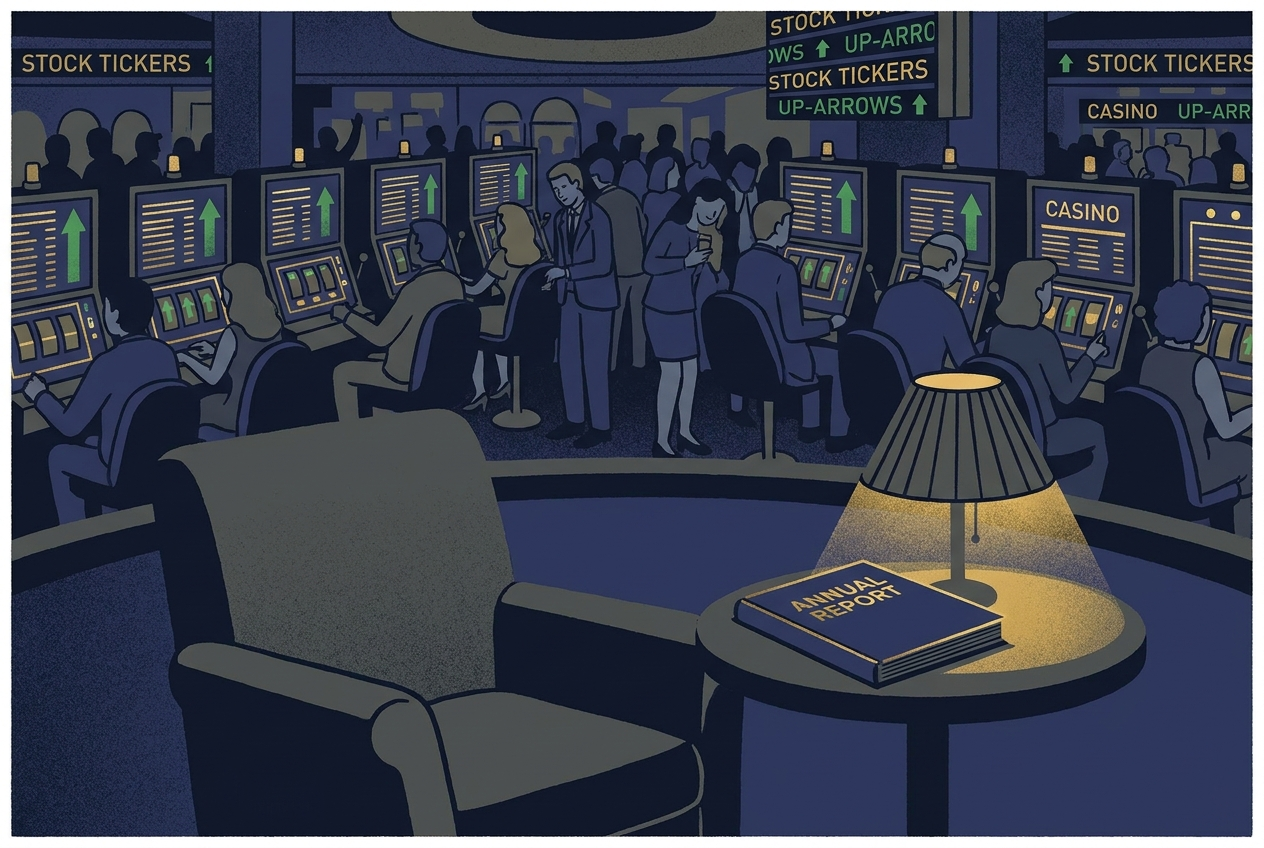
Warren Buffett has spent his life warning about one thing above all others: speculation dressed up as investing. He wrote that markets now show far more casino-like behavior than when he was young. At the 2026 annual meeting he went further, calling the market a church with a casino bolted to its side and saying he had never seen people in a more gambling mood.
You can see it everywhere. People buy shares in companies they cannot describe. They ignore the risk factors printed in plain English in the annual report. They assume someone will pay them more tomorrow for an asset that produces nothing today. That works until it does not.
Herd instinct feels safe. There is comfort in doing what everyone else is doing. But comfort and returns rarely sit at the same table. When prices disconnect from business value, mediocre companies make new highs every month, and that is exactly when the risk is highest. You are not being paid for the danger you are taking.
The tell. When a stock can only be justified by the next buyer, not by the cash the business will produce, you are gambling. You may win for a while. You are still gambling.
None of this predicts next quarter. I do not own a crystal ball, and I do not trust anyone who claims to. It is a statement about what the crowd is doing, and what it has always done at moments like this. Sentiment shifts toward risk. Quality falls out of fashion. Then reality returns, on its own schedule, and prices reconnect with the cash the businesses actually generate.
The math that does not care about the crowd
Step back from the noise and look at the long arc. Quality wins over time. Not every quarter. Not every year. Over a lifetime.
The cleanest example is Berkshire Hathaway. Buffett built it by buying established, undervalued businesses and holding them. From 1965 through 2024, Berkshire compounded at 19.9% a year against 10.4% for the S&P 500. Stretched over six decades, that gap is not a rounding error. It is the difference between comfortable and generational.
And the ride was not smooth. In the late 1990s, at the peak of the dotcom bubble, Buffett refused to buy overpriced technology. Berkshire fell 44% while the Nasdaq soared and Barron’s asked What’s Wrong, Warren?. The crowd said he had lost his touch. They sold. Then the bubble burst, and the people who held quality through the storm were rewarded for years.
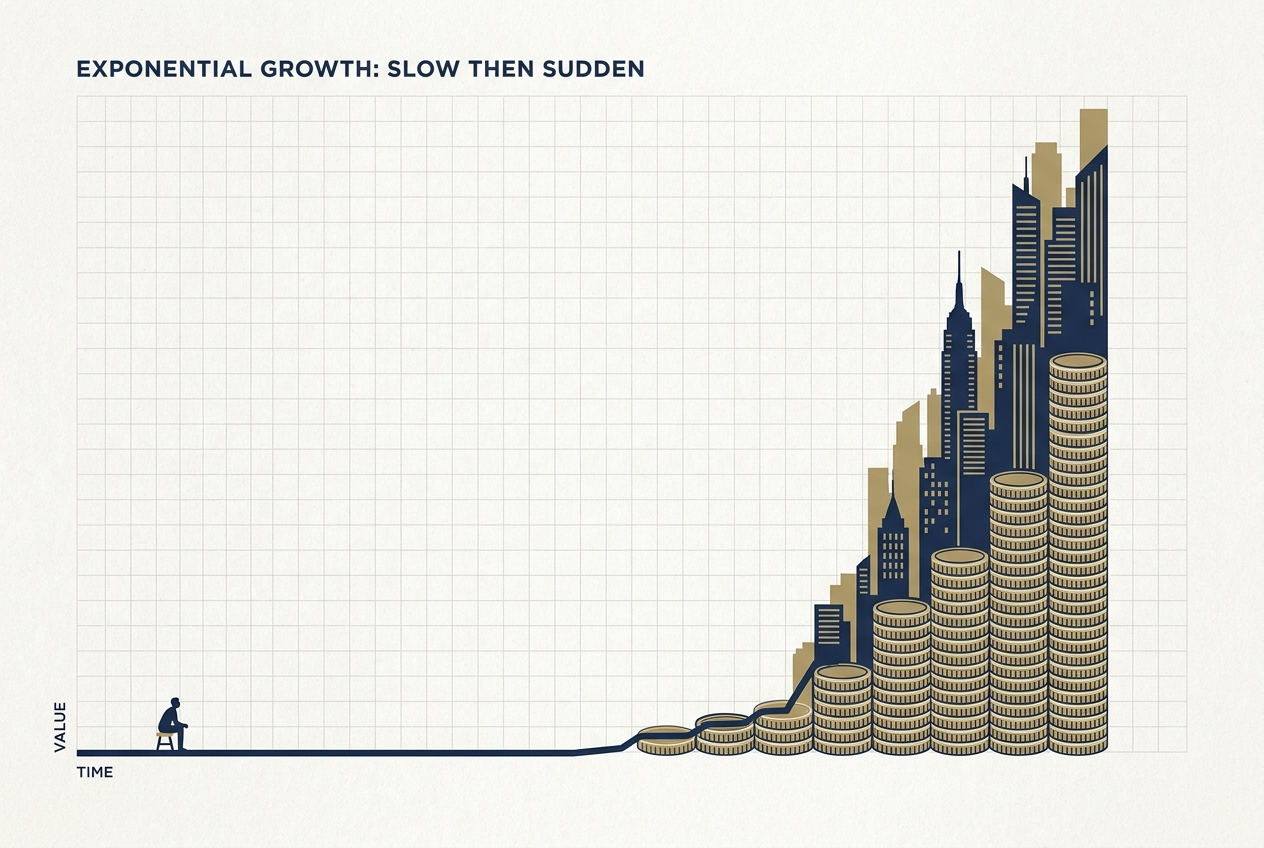
This is not opinion. It is arithmetic. A dollar that grows 12% a year doubles about every six years. Over 30 years it turns into roughly 30 dollars. Over 40 years, near 90. Stretch the runway and the curve stops looking like a line and starts looking like a wall. The hard part is never the math. The hard part is sitting still long enough to let the math work.
I want to be precise here, because I run a regulated firm and I take that seriously. I am not promising you a number. I am not telling you what any portfolio will return. I am showing you the engine. Quality businesses, held long enough, compound. That is the whole thesis, and it has held for as long as there have been public markets.
Why great companies lag in the short run
If quality wins, why does it ever lose? Because of us. Because of how investors behave.
Smart management teams wait for the right opportunities. They will not make an average investment just to post growth this quarter. They fund long projects that pay off in years, not weeks. The market, meanwhile, is impatient. It chases what is moving today and abandons what is building for tomorrow. So a great company can do everything right and still see its stock drift while the crowd is busy elsewhere.
Sentiment makes it worse. When money rushes toward risk, quality looks boring by comparison. Boring does not trend. Boring does not go viral. Boring just keeps earning high returns on capital while nobody is watching.
Burn this in. Short-term underperformance is usually a story about investor behavior, not business fundamentals. When a quality business you understand falls, the first question is not what does the price know that I do not. The first question is: did the business change, or did the mood change? Most of the time, it is the mood.
How quality behaves when markets break
Pick any crisis you remember. The dotcom crash. The global financial crisis. The COVID meltdown. In each one, quality did two things: it fell less than the broader market on the way down, and it recovered faster on the way up. Strong balance sheets, real cash flow, and pricing power are not exciting in a bull market. They are everything in a bear market.
The research is consistent. AQR’s work on the quality minus junk factor shows quality gives up ground in the early, giddy stage of a recovery and earns it back with protection during stress. Junk bounces too, but junk also goes to zero, and you only need that to happen once in a concentrated bet to undo years of gains.
Cash is not dead. Cash is optionality. We hold cash so we never have to sell a great business at the worst possible moment. It is the difference between being a forced seller in a panic and being the buyer everyone needs. The crowd treats cash as a drag. We treat it as ammunition.
The hardest thing in investing
Here is the part nobody likes to admit. The single hardest act in investing is not selling. It is buying more of a great business after it has fallen hard, when the fundamentals have not changed.
Every instinct fights you. The screen is red. The headlines are grim. The crowd is certain the story is over. Adding to the position feels almost impossible, even when your own analysis says the business is fine and the price is better than it was a month ago. I feel it too. Forty years in this work and the pull of that fear never fully goes away. You just learn to act in spite of it.
Look at Accenture, ticker ACN, a business we own. For a decade it was the textbook quality compounder. Then the market decided artificial intelligence would kill consulting and cut the stock by more than half in a year. Underneath the panic, the business kept earning a return on invested capital near 19 to 20% with billions in net cash and a dividend raised for 21 straight years.
| What the market did | What the business did | What you get now |
|---|---|---|
| Price cut by roughly half in a year | Return on invested capital held near 19 to 20% | A lower price for the same earnings |
| Multiple fell from premium to discount | Balance sheet stayed in net cash | About 10 times earnings, near a decade low |
| Repriced as if AI ends consulting | Dividend raised again, 21 straight years | Roughly double the starting dividend to wait |
Figures approximate, drawn from public sources and our internal research as of mid-2026. ACN is a position we hold.
Read that table again. The price fell by more than half. The multiple collapsed from a premium to a discount. The actual business kept earning a high return on capital, kept its net cash, and now pays you more to wait. The consulting model is evolving, not dying. Accenture is the firm that installs and runs the enterprise software that AI depends on. The fear was real. The repricing was violent. The fundamentals held.
I have lived the same script with names I own personally. I own Novo Nordisk, ticker NVO. It fell about 40% from its 2024 high as the market fretted about competition in obesity drugs, even as the underlying franchise kept compounding. I also own Eli Lilly, ticker LLY, which the market loved and bid up nearly 40% in 2025 past a trillion-dollar market cap. Same industry, opposite moods. In both cases my question is identical: did the business change, or did the crowd?
If wealth is your goal. When you do not understand a business, a falling price is a warning. When you do understand it, and the fundamentals are intact, a falling price is an invitation. The whole job is knowing which one you are looking at.
When a quality business you own goes on sale, you have two honest choices. Hold what you have with conviction. Or buy more on a plan. There is no rule that says you must act in one lurch. We add in tranches, at prices we set in advance, so the decision is made when we are calm and not when the screen is bleeding. Cold math beats hot emotion every time.
The edge you already have

Now the part most investors never hear, because the industry has no reason to tell you. You hold a structural advantage over nearly every professional managing money on Wall Street. It is not information. It is not a faster computer. It is freedom.
- No performance clock. You have no quarterly scoreboard. A fund manager who buys a falling stock and watches it fall further can lose clients, his bonus, and his job before the thesis plays out. You answer to no one but your future self. You can be early and survive it.
- No forced selling. Your capital is permanent. Institutions face redemptions at the worst moments. Research on mutual fund fire sales shows the most pressured funds push down the prices of the stocks they must dump by about 15%. When markets panic, their clients pull money and they sell quality into weakness. Your money does not run from you.
- No headline risk. You can buy what is hated. A manager carries career risk owning the out-of-favor name. If it lags, he looks foolish for being different. You carry no such burden. You are free to be a contrarian with a purpose.
- No short horizon. You can wait a decade. Most of Wall Street is measured over months. The real returns in quality show up over years and decades. Your time horizon is the one weapon the professionals cannot copy, and it is the one that matters most.
The quiet irony. People assume the pros have every advantage. On research tools and trading speed, they do. On the things that actually drive long-term returns, patience, independence, and a long horizon, the individual wins. The institution is built to chase the crowd. You are built to ignore it. Use that.
How we actually do it
Process beats prediction. Here is the discipline behind ValueAligned investing, in plain terms.
- Own great businesses, not the market. Twenty to forty businesses we understand deeply, spread across the globe and across industries. Concentrated enough to matter, diversified enough to survive being wrong on any one name.
- Measure value, not vanity. Judge each one by economic profit, returns on capital, and free cash flow. Not by EPS or EBITDA, which can be engineered. We want companies that earn well above their cost of capital and reinvest at high rates.
- Demand a margin of safety. Pay a price that leaves room to be wrong. Graham called margin of safety the three most important words in investing. Quality alone is not enough. Quality at a sensible price is the whole game.
- Back aligned managers. Favor owner-operators who allocate capital like the business is theirs. Alignment is not a soft factor. It compounds or it leaks, every single year.
- Hold for life, add on sale. Hold for the long run, tax-efficiently, and add to conviction on weakness using a plan set in advance. Hold cash so we are never forced sellers.
Process over feeling. The plan exists so that when the screen turns red, we execute a decision we already made instead of inventing a new one under stress. That is what separates an owner from a sheep.
The real risk is not volatility
Wall Street trained you to fear the wrong thing. It taught you that risk is a number on a screen that wiggles. Volatility. Drawdown. The red days. So the standard advice is to de-risk as you age, trade growth for safety, and accept a smaller engine for a smoother ride.
Here is the truth the industry buries. For most families, the real risk is not a volatile decade. It is running out of money. Survey after survey finds that outliving assets is the single greatest retirement fear, ahead of almost everything else, including for many people the fear of dying. A 30-year retirement funded by a portfolio built to barely move is the danger nobody names. Volatility you can sleep through. Running out of capital at 85 you cannot.
Own the engine. Owning quality businesses for life, bought at sensible prices and held through the storms, is not the reckless choice. It is the conservative one, measured over the horizon that actually matters. The reckless choice is renting returns, chasing trends, and arriving at retirement with an engine too small to last.
So, are you a sheep?
The crowd will keep chasing what is hot. It always has. That is not a flaw in the market. It is the source of your opportunity. Every time fear pushes a great business below its worth, someone has to be on the other side of that trade. It might as well be you.
Quality investing is not dead. It is on sale, and it is unpopular, which is usually the same thing. The discipline is simple to describe and hard to live. Own great businesses. Measure them by the cash they truly earn. Buy them with a margin of safety. Hold them for life. Add when the crowd flees, on a plan, with a clear head. Then let compounding do what compounding does.
That is ValueAligned investing. That is compounding quality. Same idea, sharper tools, and an edge that already belongs to you. The only question left is whether you will use it, or follow the herd.
If you want to see how this discipline is built into a real portfolio, that is the work we do at VAP Wealth Advisors. And every week at Berk on Value, I teach the playbook in plain language, no jargon, no hype.
Endnotes
1. margin of safety – Benjamin Graham’s central concept, buying below intrinsic value, explained by GrahamValue. https://www.grahamvalue.com/blog/margin-safety-value-investing
2. compounded near 20% a year from 1965 through 2024 – CNBC on Berkshire Hathaway’s 60-year return record under Warren Buffett. https://www.cnbc.com/2025/05/05/warren-buffetts-return-tally-after-60-years-5502284percent.html
3. compounded at 19.9% a year against 10.4% for the S&P 500 – Visual Capitalist on Berkshire versus the S&P 500, growth of $100, 1965 to 2025. https://www.visualcapitalist.com/warren-buffett-vs-the-sp-500-growth-of-100-1965-2025/
4. fell 44% while the Nasdaq soared and Barron’s asked What’s Wrong, Warren? – Marcellus on Buffett’s dotcom-era underperformance and the 1999 Barron’s cover. https://marcellus-us.com/story/has-warren-buffett-lost-his-touch/
5. markets now show far more casino-like behavior – Fortune on Buffett’s 2024 Berkshire shareholder letter comparing markets to a casino. https://fortune.com/2024/02/26/warren-buffett-berkshire-hathaway-earnings-stock-market-casino-like/
6. a church with a casino bolted to its side – CNBC transcript of Buffett at the 2026 Berkshire annual meeting. https://www.cnbc.com/2026/05/02/cnbc-transcript-berkshire-hathaway-chairman-warren-buffett-sits-down-with-cnbcs-becky-quick-during-the-2026-berkshire-hathaway-annual-meeting-today-.html
7. greater fool theory – Corporate Finance Institute overview of speculation based on selling to a greater fool. https://corporatefinanceinstitute.com/resources/wealth-management/greater-fool-theory/
8. return on capital minus the cost of that capital – Stern Value Management on Economic Value Added, the framework built by Stern Stewart. https://sternvaluemanagement.com/economic-value-added-eva
9. economic value added framework / economic profit – Aswath Damodaran, NYU Stern, lecture notes on EVA and economic profit. https://pages.stern.nyu.edu/~adamodar/New_Home_Page/lectures/eva.html
10. recovered faster on the way up – AQR on defensive factor strategies and downside protection. https://funds.aqr.com/Insights/Strategies/Defensive-Factor
11. quality minus junk factor / fall less and recover faster – AQR on the quality factor, profitability, safety, and behavior through market stress. https://funds.aqr.com/Insights/Strategies/Quality-Factor
12. cut the stock by more than half in a year – Tickeron on Accenture’s sharp decline following an earnings miss and guidance cut. https://tickeron.com/blogs/accenture-acn-stock-declines-36-7-over-30-days-following-earnings-miss-and-guidance-cut-14411/
13. return on invested capital near 19 to 20% with net cash and 21 years of dividend growth – Seeking Alpha analysis of Accenture’s quality metrics amid AI uncertainty. https://seekingalpha.com/article/4897905-accenture-acn-high-quality-undervalued-dividend-growth-stock-amid-ai-uncertainty
14. fell about 40% from its 2024 high – CNBC on Novo Nordisk’s decline and obesity-drug competition with Eli Lilly. https://www.cnbc.com/2026/02/25/novo-nordisk-stock-nvo-lly-eli-lilly-ozempic-weight-loss-obesity.html
15. bid up nearly 40% in 2025 past a trillion-dollar market cap – The Motley Fool on Eli Lilly’s 39.2% gain in 2025 driven by Zepbound and Mounjaro. https://www.fool.com/investing/2026/01/14/why-eli-lilly-stock-gained-392-in-2025/
16. most pressured funds push down prices by about 15% – Coval and Stafford, asset fire sales in equity markets, via the Federal Reserve Bank of New York. https://www.newyorkfed.org/medialibrary/media/research/conference/2005/liquidity/Coval_Stafford.pdf
17. redemptions that force selling into weakness – Liberty Street Economics, Federal Reserve Bank of New York, on asset managers and fire-sale vulnerability. https://libertystreeteconomics.newyorkfed.org/2016/02/are-asset-managers-vulnerable-to-fire-sales/
18. outliving assets is the single greatest retirement fear – Cerulli Associates on outliving assets as savers’ and retirees’ greatest fear. https://www.cerulli.com/press-releases/for-retirement-savers-and-retirees-outliving-assets-is-their-greatest-fear
19. longevity risk and declining finances in older age – Transamerica Institute research on longevity risk among retirees and pre-retirees. https://www.transamericainstitute.org/research/publications/details/longevity-risk-retirees-and-pre-retirees-fear-declining-finances-and-deteriorating-health-in-older-age
Disclosure
This article is for educational and entertainment purposes only. Nothing here is investment advice, tax advice, legal advice, or accounting advice. I am not your CPA, accountant, attorney, or tax professional, and I am not acting as your financial advisor in this article.
Investing involves risk, including loss of principal. Past performance does not predict future results. Markets, tax law, and individual circumstances change. Before acting on anything you read here, consult a qualified professional who knows your full situation.
Position disclosure: I, members of my family, and clients of VAP Wealth Advisors may own positions in the security or securities discussed in this article. I may buy, sell, add to, or trim those positions at any time without prior notice and without updating this article. Nothing said here should be taken as a recommendation to buy, sell, or hold any specific security.
Views expressed are my own and do not necessarily reflect the views of VAP Wealth Advisors.
Regulatory Information
ValueAligned Partners LLC is a Registered Investment Advisor. For additional information, please refer to our Form ADV, available on the SEC’s website at www.adviserinfo.sec.gov.