

A fee business booked a nine-figure loss. Three months earlier, the CFO said it would not be material.
Markel booked a $205.3 million provision for expected credit losses on reinsurance recoverables in the second quarter. One reinsurer went bankrupt. The collateral behind it was not enough. What follows is the timeline, what management said at each step, and the part that transfers to every company you will ever own.
A fee business just produced a nine-figure loss
Markel Group reported second-quarter results after the close on July 29. Buried in the 10-Q, not in the press release, was a single line that cost more than any storm the company faced this year.
The filing says Markel recorded a $205.3 million provision for expected credit losses on reinsurance recoverables1 within State National’s program services fronting operations, all of it tied to one capacity provider that is currently in bankruptcy. The provider is not named.
Watch what that did to one number. The allowance Markel holds against reinsurance it may never collect went from $18.1 million at year-end to $234.4 million. That is a thirteen-fold increase in six months.
The charge dropped the Financial segment to a $148.9 million operating loss, against a $78.4 million profit a year earlier. Adjusted operating income for the whole company fell 25%15. Adjusted earnings per share came in at $19.51 against a $29.94 estimate13, a 35% miss.
Here is why that matters more than the dollar figure. Fronting is sold as a fee business. Losing money on it is not supposed to be one of the outcomes.
What fronting is, and why nobody expected this
Start with the plumbing, because the whole story lives there.
An insurance license is hard to get. Fifty states, capital requirements, ratings, filings. Plenty of companies want to sell insurance without building all that. So they rent it.
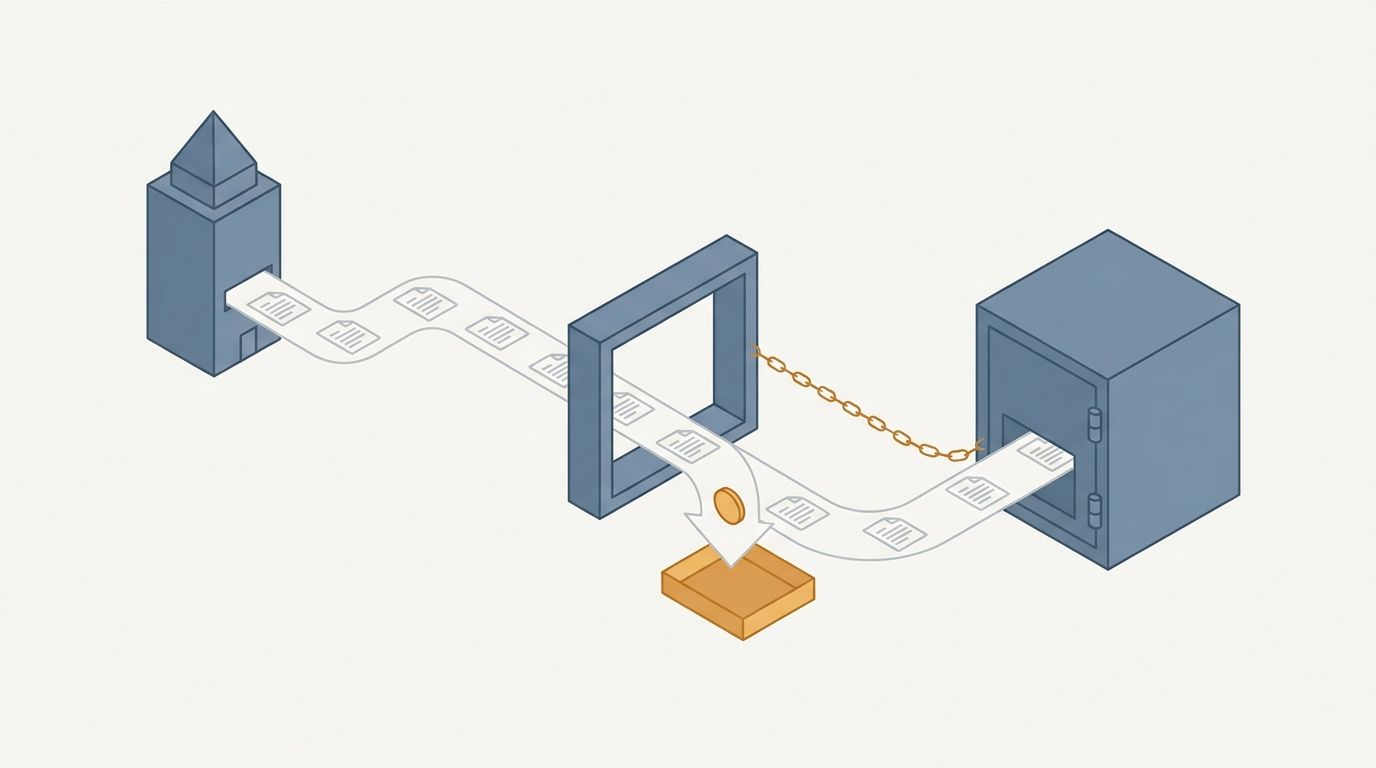
State National is the landlord. Markel bought it in 2017. The arrangement works like this. State National writes the policy and puts its name and its license on the paper. Behind the scenes, a reinsurer essentially agrees to take all the risk. State National keeps a fee, usually a small percentage of premium, and passes the claims through.
Tom Gayner told analysts on the July call that Markel paid roughly $900 million for State National12 and that the business has earned back more than a billion dollars since. The math on the acquisition is fine. What broke was the mechanism.
The collateral is the whole safety system
A reinsurer taking risk off a fronting carrier has to post collateral. Cash, a letter of credit, or a trust account. If the reinsurer fails, the collateral pays the claims, and the fronting carrier walks away clean.
Notice the assumption hiding in that sentence. Collateral is sized against an estimate of future losses. Somebody has to decide how big the losses will be, and then collect that much security.
Get the estimate right, and the system works. Get it wrong, and the gap between the collateral you collected and the claims you actually owe becomes your problem. Not the reinsurer’s. Yours.
Read the timeline, then read what management said

This is the part worth studying, and it takes about four minutes.
| When | What Markel said or did | The number |
|---|---|---|
| Dec 31, 2025 | Statutory filings showed collateral roughly matching the recoverable on this relationship | Allowance for credit losses: $18.1M |
| Q1 2026 | Markel raised the loss ratio on the affected programs “a little bit” in reaction to claims trend. The Q1 10-Q5 carried no company-specific collateral disclosure | Not disclosed |
| Apr 29, 2026 | CFO Brian Costanzo, in prepared remarks, acknowledged a collateral shortfall and said it would not be material to earnings or capital | Declined to size it |
| Apr to Jun 2026 | Markel pulled more granular program data, ran its own ground-up review, and hired an outside actuarial firm | — |
| Jul 29, 2026 | Markel recorded the provision and disclosed it in the 10-Q, not the press release | $205.3M charge; allowance now $234.4M |
The April exchange, in their own words
Andrew Andersen of Jefferies had done the homework. He went to the statutory annual statement, found collateral near 100% of the recoverable at year-end, and asked the obvious question: had there been loss development, or was the shortfall in the low single-digit millions?
Costanzo’s answer is the one to hold on to. He said Markel increased that loss ratio a little bit in the first quarter4 in reaction to the incurred claims trend, and that this is what creates the shortfall. He declined to give a number. He also said Markel did not believe the situation would have a material impact on earnings or capital position3.
Both statements were accurate descriptions of what Markel knew in April. Neither survived July.
Andersen said as much on the second-quarter call. His words: he was surprised to see such a big change after one quarter.
The question that did not get answered
Two analysts asked the same thing in different words, and the answer never arrived.
Tracy Benguigui of Wolfe Research opened the Q&A. She wanted to know whether the third-party actuarial team looked only at the bankrupt reinsurer, or whether it also reviewed the adequacy of collateral behind all of Markel’s unrated reinsurance partners backing much larger liabilities.
Gayner confirmed the engagement covered that one contract. Pressed a second time on the general health of collateral behind unrated counterparties, he answered with reserving philosophy — a number more likely to be redundant than deficient, and the first loss of this kind in over 40 years of State National history. Both true. Neither is a scope answer.
Andersen tried the other end of the same question. Why not engage the firm to review reserve adequacy across the broader State National platform? Costanzo described what Markel did after the fact and moved on.
Then somebody said the quiet part
Late in the call, Andrew Crowley added a detail nobody asked for. Answering a question about how Markel manages aggregation, he said that as a result of this work, Markel will require collateral top-ups for similar lines of business with other reinsurers — reinsurers he described as financially healthy.
The review was scoped to one contract. The remediation was not.
Nobody followed up.
The good quarter nobody talked about
A charge that size swallows a call. It should not swallow the analysis, because the operating business had its best stretch in years.
Quick definition first. A combined ratio is claims plus expenses divided by premiums. Under 100% means the insurance itself made money before any investment income. Most insurers spend decades trying to hold a number in the low 90s.
Markel Insurance printed a 92.9% combined ratio2 in the quarter against 96.9% a year earlier. That was the fourth consecutive quarter near 93%: 93% in the third quarter of 202511, 92.9% in the fourth8, 92.8% in the first quarter of 2026, and 92.9% now.
First-half underwriting profit doubled, from $143.4 million to $284.4 million. Strip out catastrophes and the second-quarter number was 90.8%, with the exited reinsurance book still costing two points as it runs off.
Shrinking and growing at the same time
Headline premium fell 11%. That reads like a business in retreat until you see what was removed.
Markel sold the renewal rights to its Global Reinsurance division in August 2025 and put it in run-off. Separately, the Hagerty classic-car book converted to a pure fronting arrangement21 on January 1, 2026. Management told investors those two changes alone would remove roughly $2 billion of 2026 gross written premium7.
Excluding both, premium grew 10%. So the book Markel wants is growing at a double-digit rate while the book it does not want disappears. Doing one of those is common. Doing both at once, and holding the combined ratio while you do, is not.
None of this happened by accident. Markel’s board announced a business review in February 202518 after pressure from activist investor JANA Partners17. Simon Wilson was named CEO of Markel Insurance19 the following month, and the US business was reorganized into divisions with standalone profit-and-loss ownership20. Four quarters of consistent results is the first hard evidence the reorganization changed behavior rather than the org chart, and the 2026 proxy10 now ties Wilson’s pay to group-wide criteria.
The AI story is real, and smaller than it sounds
Wilson spent more prepared remarks on artificial intelligence than on anything else. The numbers he gave are specific: six classes of business rewired over twelve months, covering more than $500 million of existing premium, with time to a first risk assessment cut by 50% to 90% and accuracy above 90%.
Those are good numbers. They also cover a narrower slice of the business than a casual listener would assume, and the vendor name tells you why.
Markel’s partner on that work is Harvey. Harvey is not insurance software. It is a legal AI platform22 whose published use cases are contract analysis, due diligence, compliance, and litigation, and which was valued at $11 billion in a March 2026 funding round24. More than 75 of the AmLaw 100 law firms use it.
Harvey has its own case study on Markel. Bryan Dressler, who runs the warranty and indemnity team, adopted it in early 2025 to review due diligence reports on merger transactions23. His description of the result: what used to take an hour and a half to two hours now takes about fifteen minutes.
Look at the lines Wilson has named across four calls. London warranties and indemnities. US financial institutions. Environmental. Every one is a document-heavy, contract-reading problem. A warranty underwriter is reading a share purchase agreement and a diligence report to decide whether to insure the promises inside it. That is legal work sitting inside an insurance company, and Harvey was built for exactly that.
What Harvey does not touch is property, marine, personal lines, or the US casualty book — which is where the loss ratio problem actually lives. Markel uses different tools there: Cytura for data ingestion, and hyperexponential for pricing, where the company publicized a 113% underwriting productivity gain25 in 2025.
One number to watch. Markel’s expense ratio was 36.1% for 2025 and 35.7% this quarter. If AI is cutting cycle times by 50% to 90% across $500 million of premium, that is where it should eventually show up. Across four earnings calls, not one analyst has asked an AI question.
What the business is worth, using Markel’s own math

Markel publishes its own intrinsic value method6, which is unusual and useful. Two pieces, added together.
The first piece is a three-year average of adjusted earnings times a multiple. Markel shows 8x, 12x, and 16x, and calls 12x the midpoint. The second piece is a balance sheet total: cash, plus short-term investments, plus the stock portfolio, minus debt, preferred stock, and minority interests.
The trick most people miss
Bonds are not added, and insurance float is not subtracted. Both are left out on purpose.
The reason is clean. Float is money collected from policyholders that has not been paid out yet. It funds the bond portfolio. Bonds sit on the asset side, the reserves sit on the liability side, and for a shareholder, they roughly cancel. Adding the bonds while ignoring the float would count the same money twice. At June 30th, Markel held $17.7 billion of bonds against $16.4 billion of net loss reserves, so the two really do net out to something small.
Run the method at the June 30th balance sheet and the answer looks like this.
| Earnings multiple | Value per share | Discount to that value |
|---|---|---|
| 8x (Markel’s low end) | $2,190 | 14% |
| 12x (Markel’s midpoint) | $2,705 | 30% |
| 16x (Markel’s high end) | $3,220 | 41% |
Against a share price of $1,891.50 on July 30, after the stock fell 6.1% from the prior close.
One check on the arithmetic. Rebuilding Markel’s published inputs from 2020 through 2025 and computing the five-year growth rate returns 14.5%, 15.2%, and 15.7% at those three multiples. Markel published 14.5%, 15.2%, and 15.7%. The reconstruction matches on all three.
Now the part that keeps this honest
Markel is almost always cheap on this measure. At each year-end since 2020, the share price sat at 80%, 80%, 75%, 68%, 73%, and 81% of the 12x value. Today it is 70%.
That is a persistent discount, not a fresh mispricing. JANA Partners argues the discount is structural and will not close until Markel separates its non-insurance businesses16. Across four consecutive earnings calls, no analyst asked management about it. Not once.
Worth knowing: Markel removed book value per share from its 2025 annual report and replaced it with this framework, and made the same case in its 2025 shareholder letter9. A company grading itself with a measure only it calculates deserves a raised eyebrow, even when the measure is a good one.
The lesson that outlives this stock
Forget Markel for a second. Two things happened here that repeat across every company you will ever own.
“Not material” has a shelf life
When a CFO says something is not material, listen for what the sentence is standing on. In April, Markel had run its own review and had not yet pulled the granular program data. The statement described what the company knew. It did not describe what was true.
That is not deception. That is the ordinary lag between when a company starts counting and when it finishes. Your job as an owner is to notice which one you are hearing.
Watch the scope of the answer, not the tone of it
Benguigui and Andersen both asked about scope. Both got history and philosophy back. History and philosophy are not scope.
Gayner’s 40-year point was accurate and reassuring, and it answered a question nobody had asked. The one that was asked — how much uncollateralized exposure sits across the rest of the platform — is still open. Crowley’s remark about collateral top-ups with other reinsurers is the only sizing signal in the entire transcript, and it is qualitative.
Two numbers can both be true
Markel reported GAAP earnings of $92.76 per share and beat the consensus estimate handily14. The same company reported adjusted earnings of $19.51 and missed by 35%. Both figures are correct. The gap between them was $1.17 billion of paper gains on the stock portfolio, which say nothing about how the insurance business performed.
An insurer’s stock portfolio will hand you a spectacular quarter and a terrible one for reasons that have nothing to do with underwriting. Find the number that measures the business. For an insurer, that is the combined ratio and the underwriting profit. For this quarter, both were good, and the loss came from somewhere else entirely.
What to watch on the next call
Three questions will settle whether this quarter was an event or a pattern.
How much uncollateralized reinsurance recoverable sits across the rest of State National, and across how many programs? Crowley said top-ups are coming with other reinsurers. Nobody has sized that.
Does the combined ratio hold at 93% through hurricane season? Four quarters is the shortest stretch that can be called a run rate. A fifth and sixth make it a record.
When does the AI work move the expense ratio? The number has gone from 36.1% to 35.7% while six classes of business were rewired. Cycle times are not the same as costs.
Get the next one in your inbox.
Plain-English investing, one idea at a time, from a manager who has watched forty years of market cycles.
Notes
- $205.3 million provision for expected credit losses on reinsurance recoverables — Markel Group Form 10-Q for the quarter ended June 30, 2026 — source for the charge, the allowance movement from $18.1M to $234.4M, the balance sheet, and the reserving-philosophy language. https://www.sec.gov/Archives/edgar/data/1096343/000109634326000064/mkl-20260630.htm ↩
- 92.9% combined ratio — Markel Group second quarter and six months 2026 results press release, July 29, 2026 — combined ratio, segment results, underwriting profit, and buybacks. https://www.prnewswire.com/news-releases/markel-group-reports-2026-second-quarter-and-six-months-results-302838279.html ↩
- would not have a material impact on earnings or capital — Markel Q1 2026 earnings call transcript, April 29, 2026 — Brian Costanzo’s prepared remarks and the Andrew Andersen exchange on statutory collateral. https://www.fool.com/earnings/call-transcripts/2026/04/29/markel-mkl-q1-2026-earnings-call-transcript/ ↩
- increased that loss ratio a little bit in the first quarter — Same transcript — the exchange establishing that Markel’s own Q1 loss-pick increase created the collateral shortfall. https://www.fool.com/earnings/call-transcripts/2026/04/29/markel-mkl-q1-2026-earnings-call-transcript/ ↩
- Markel Q1 2026 Form 10-Q — Filed April 28, 2026 — contains no company-specific State National collateral disclosure, only generic reinsurance credit risk language. https://www.sec.gov/Archives/edgar/data/1096343/000109634326000041/mkl-20260331.htm ↩
- published intrinsic value method — Markel Group FY2025 Form 10-K, Item 7 MD&A, “Intrinsic Value Per Share Growth,” pages 35-36 — the methodology, the adjusted earnings build, the balance sheet components, the 8x/12x/16x multiples, the published five-year growth rates, and the removal of book value per share. https://www.sec.gov/Archives/edgar/data/1096343/000109634326000020/mkl-20251231.htm ↩
- remove roughly $2 billion of 2026 gross written premium — Markel Group fourth quarter 2025 earnings call transcript, February 5, 2026 — the quantified premium headwind from the Global Reinsurance exit plus the Hagerty conversion. https://s202.q4cdn.com/749045284/files/doc_financials/2025/q4/Markel-Group-Fourth-Quarter-2025-Earnings-Call.pdf ↩
- 92.9% in the fourth — Markel Group 2025 financial results, Form 8-K Exhibit 99.1, February 4, 2026 — full-year and fourth-quarter combined ratio and underwriting profit. https://www.sec.gov/Archives/edgar/data/1096343/000109634326000008/mkl02042026exhibit991.htm ↩
- 2025 Shareholder Letter — Filed as an 8-K exhibit February 26, 2026 — intrinsic value growth commentary and buyback detail. https://www.sec.gov/Archives/edgar/data/1096343/000109634326000021/mkl2025shl.htm ↩
- 2026 proxy statement — Markel Group DEF 14A filed April 2, 2026 — executive compensation structure, five-year performance metrics, and the February 2026 change moving Simon Wilson onto group-wide criteria. https://www.sec.gov/Archives/edgar/data/1096343/000109634326000033/mkl-20260401.htm ↩
- 93% in the third quarter of 2025 — Markel Group third quarter and nine months 2025 results press release, October 29, 2025. https://www.prnewswire.com/news-releases/markel-group-reports-2025-third-quarter-and-nine-months-results-302598947.html ↩
- paid roughly $900 million for State National — Markel Q3 2025 earnings call transcript, October 30, 2025 — State National acquisition context and the fronting-competition exchange. https://www.insidermonkey.com/blog/markel-corporation-nysemkl-q3-2025-earnings-call-transcript-1638534/ ↩
- $19.51 against a $29.94 estimate — Zacks earnings analysis, July 29, 2026 — adjusted EPS versus consensus. https://www.zacks.com/stock/news/2963992/markel-group-mkl-misses-q2-earnings-estimates ↩
- beat the consensus estimate handily — StockStory earnings coverage, July 29, 2026 — GAAP EPS versus estimate and the initial share price reaction. https://stockstory.org/us/stocks/nyse/mkl/news/earnings/markel-group-nysemkl-posts-better-than-expected-sales-in-q2-cy2026 ↩
- Markel Q2 2026 results summary — StockTitan coverage of the July 29, 2026 release — adjusted operating income decline. https://www.stocktitan.net/news/MKL/markel-group-reports-2026-second-quarter-and-six-months-44w9fvky9g46.html ↩
- will not close until Markel separates its non-insurance businesses — JANA Partners letter to the Markel Group board of directors, April 30, 2026 — the activist case for separating Markel Ventures plus a tender offer. https://www.prnewswire.com/news-releases/jana-partners-sends-letter-to-markel-group-board-of-directors-302759189.html ↩
- after pressure from activist investor JANA Partners — Carrier Management coverage of Markel’s February 2025 board-led business review. https://www.carriermanagement.com/news/2025/02/06/271493.htm ↩
- Markel Group shareholder update — February 5, 2025 announcement of the board business review, including the reference to shareholder feedback. https://www.prnewswire.com/news-releases/markel-group-inc-provides-update-for-its-shareholders-302369414.html ↩
- was named CEO of Markel Insurance — Markel announcement of Simon Wilson’s appointment, March 2025. https://www.markel.com/about-us/news-and-press/markel-group-appoints-simon-wilson-as-chief-executive-officer-of-markel-insurance ↩
- was reorganized into divisions with standalone profit-and-loss ownership — Markel Insurance divisional structure and leadership announcement, April 22, 2025. https://www.stocktitan.net/news/MKL/markel-insurance-announces-new-divisional-structure-and-leadership-1clxd5kku0qn.html ↩
- converted to a pure fronting arrangement — Hagerty newsroom, letter of intent for the new fronting arrangement with Markel under which Hagerty Re assumes 100% of the premium. https://newsroom.hagerty.com/press/hagerty-announces-loi-for-new-fronting-arrangement-with-markel-hagerty-re-to-assume-100-of-the-premium/ ↩
- legal AI platform — Harvey company page — industries served, customer base, and published use cases. No insurance offering listed. https://www.harvey.ai/company ↩
- adopted it in early 2025 to review due diligence reports on merger transactions — Harvey case study featuring Bryan Dressler, Director of Warranty and Indemnity at Markel — the ninety-minutes-to-fifteen-minutes figure. https://www.harvey.ai/blog/harvey-power-users-the-skill-youre-sharpening ↩
- valued at $11 billion in a March 2026 funding round — CNBC coverage of Harvey’s funding round, March 25, 2026. https://www.cnbc.com/2026/03/25/legal-ai-startup-harvey-raises-200-million-at-11-billion-valuation.html ↩
- hyperexponential for pricing, where the company publicized a 113% underwriting productivity gain — Insurance Business coverage of Markel’s hyperexponential deployment, 2025. https://www.insurancebusinessmag.com/uk/news/technology/markels-underwriting-productivity-skyrockets-113-with-ai-460759.aspx ↩
- Form ADV Part 2A and Form CRS — Investment Adviser Public Disclosure — adviser registration records referenced in the disclosures below. https://adviserinfo.sec.gov ↩
Important Disclosures
This content is produced by David Berkowitz under ValueAligned Partners, LLC, DBA VAP Wealth Advisors (“VAP Wealth Advisors”), an independent marketing brand, and is provided for general educational and informational purposes only. It is not, and should not be construed as, personalized investment, legal, tax, or accounting advice, nor an offer or solicitation to buy or sell any security.
No advisory relationship. Viewing, reading, or interacting with this content does not create an investment-adviser, attorney-client, or accountant-client relationship. David Berkowitz is an investment adviser representative registered with Savvy Advisors, Inc. (“Savvy”), and all investment advisory services he provides are offered through Savvy. Investment advisory services are offered only through a written agreement with Savvy. ValueAligned Partners, LLC, DBA VAP Wealth Advisors, is an independent marketing brand used for advertising and marketing purposes only; ValueAligned Partners, LLC and Savvy are not related or affiliated. Additional information is available in Savvy Advisors’ Form ADV Part 2A and Form CRS at adviserinfo.sec.gov.
Not legal or estate-planning advice. David Berkowitz is not an attorney, and VAP Wealth Advisors does not practice law, draft legal documents, or provide legal opinions. Any discussion of wills, trusts, powers of attorney, beneficiary designations, or other estate-planning topics is general education only. You should consult a licensed attorney in your state before drafting, signing, or relying on any estate-planning document.
Not tax or accounting advice. David Berkowitz is not a CPA or Enrolled Agent, and VAP Wealth Advisors does not prepare tax returns or provide tax-return preparation services. Any discussion of tax topics is general education intended to help you understand tax-planning concepts and coordinate with your CPA or tax preparer. You should consult a qualified tax professional regarding your specific situation before acting on anything discussed here.
No guarantees; investment risk. All investing involves risk, including possible loss of principal. Past performance is not indicative of, and does not guarantee, future results. Forward-looking statements are opinions as of the date recorded and are subject to change without notice.
Sources and third-party content. Links, tickers, and third-party materials are provided for convenience and do not constitute an endorsement. VAP Wealth Advisors is not responsible for the content of third-party sites.
Positions. David Berkowitz, his clients, employees, and family may own the stocks mentioned in this content. He is under no obligation to update the content or to disclose any future purchases or sales of those stocks.
References to specific securities are for illustration and education only and are not a recommendation to buy, sell, or hold any security. Whether a particular security is appropriate for an individual investor depends on that investor’s objectives, risk tolerance, financial circumstances, tax situation, and investment time horizon. Investors should consult their own financial, tax, and legal advisers regarding the suitability of any investment for their individual circumstances.
David Berkowitz, SAVVY clients, and family may hold positions in securities discussed, and those positions may change at any time without notice. Individual holdings depend on each client’s objectives, risk tolerance, tax situation, and time horizon. Consult your own adviser regarding suitability for you. David Berkowitz, his clients, employees, and family may own the stocks mentioned in this content. He is under no obligation to update the content or to disclose any future purchases or sales of those stocks.
All advisory services are offered through Savvy Advisors, Inc. (“Savvy Advisors”), an investment advisor registered with the Securities and Exchange Commission (“SEC”). Savvy Wealth Inc. (“Savvy Wealth”) is a technology company and the parent company of Savvy Advisors. Savvy Wealth and Savvy Advisors are often collectively referred to as “Savvy”.
David L Berkowitz is an investment advisor representative registered with Savvy Advisors, Inc. (“Savvy”). All investment advisory services offered by David L Berkowitz are offered through Savvy. ValueAligned Partners, LLC (also doing business as VAP Wealth Advisors) is an independent marketing brand name used by David L Berkowitz for advertising and marketing purposes only. ValueAligned Partners, LLC and Savvy are not related or affiliated. For more information about Savvy, please visit our website at savvywealth.com/advisor.





3 Responses
Good read! Sharing Luna Lisa Alpha () — handy for packaging, labels and photoreal stills.. Luna Lisa Alpha
Ótimo post! Texto para imagem com Swift-image em Swift-image: . Swift-image
Appreciate the depth in this piece. For speaker labels, timestamps and TXT/SRT/VTT export, see Gem Transcribe at . Gem Transcribe