
Profits are growing and borrowing got more expensive. That tug-of-war picked the winners and losers from October 5 to 9, 2026, and it tells you what to check in the stocks you own.
By David Berkowitz · Berk on Value · October 11, 2026
Companies are earning more money. Money also costs more to borrow. From October 5 to 9, 2026, that tug-of-war decided which stocks rose and which fell, and it explains a lot about the stock market this week.
Here is the plain-English version: what moved, why it moved, and the one question I ask about every company I research for clients.
1. Higher interest rates can pull stock prices down
Picture a lemonade stand that earns $100 a year. If a safe savings account paid 2%, you might pay $2,000 for that stand. Now say the savings account pays 5%. The stand looks less special, so you’d pay less for it. Nothing changed at the stand. Your other choice got better.
Stocks work the same way. When interest rates rise, investors can earn more from safer places, so they pay less for each dollar of company profit. Economist Ed Yardeni laid out both sides of this in two notes this week: an earnings outlook he calls the Roaring 2020s1, and a spectrum of reasons bond yields are rising9. In my view, the balance between those two forces matters more to a long-term owner than any single day of trading.

2. Four funds told four different stories
An ETF, short for exchange-traded fund, is one basket that holds many stocks at once. I watch four of them to take the market’s temperature.
| Fund | What it tracks | Week | Year to date |
|---|---|---|---|
| RSP | S&P 500, equal weights | +1.6%2 | +12.5% |
| SPY | S&P 500, weighted by company size | +1.2%3 | +15.1% |
| QQQ | Nasdaq-100 | +0.2%10 | +22.7% |
| IWM | Russell 2000 small companies | -0.9%4 | +14.1% |
Total return with dividends from Oct. 2 to Oct. 9, 2026, and from Dec. 31, 2025 to Oct. 9, 2026, based on adjusted daily closes from Yahoo Finance. These figures are based on historical market data over the periods studied and are provided for educational purposes only. Past performance does not guarantee future results.
When the equal-weight ETF beats the regular one, more companies joined the rally beyond a handful of giants. Small companies still fell, so this was no everybody-wins week.
3. Safe businesses and energy led the sectors
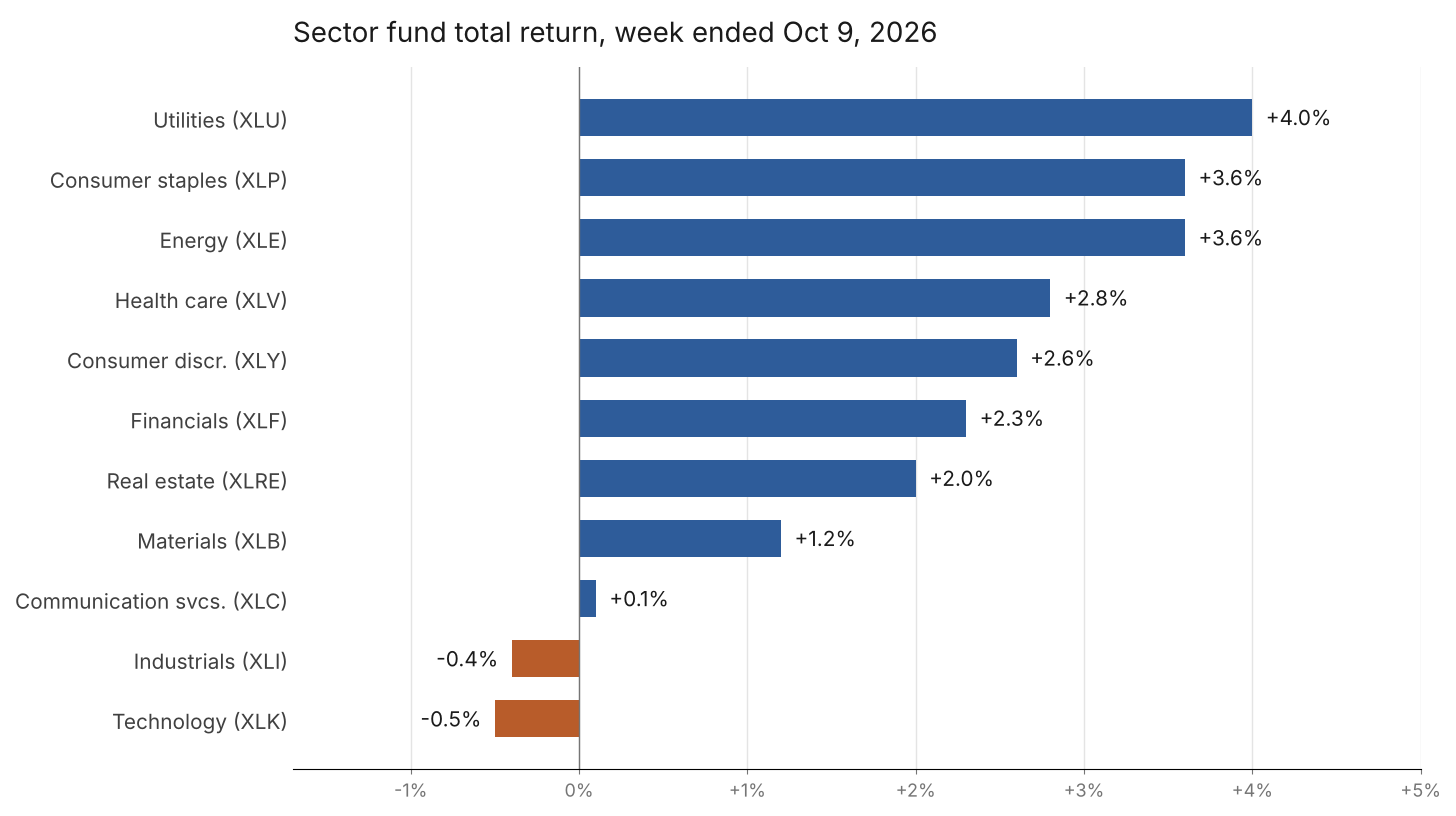
A sector is a group of companies that do similar work. Utilities led the week (XLU, +4.0%)11. Those are the power and water companies that send you a monthly bill. Consumer staples, the things people buy no matter what, and energy came next. Technology was one of only two sectors that fell (XLK, -0.5%)12.
Keep one week in perspective. Utilities finished the week still slightly down for the year, while technology remained up sharply for the year. A strong week can be a bounce. It does not prove a new long-term trend.
4. Inside each group, the details changed the story
Banks are the clearest example. The broad financial sector was up for the week (XLF, +2.3%)13, so you might guess banks had a good week. They did not. Banks were down (KBE, -1.9%)14, and regional banks were down more (KRE, -2.5%)7. Insurance companies and stock-trading firms lifted the group.
Technology split the same way. Software was up (XSW, +3.4%)5 while semiconductors were down (XSD, -4.9%)6. Investors are asking harder questions about the billions being spent on AI chips and data centers, and about who pays for it all. Clients often ask me whether tech was up or down in a given week. My honest answer: it depends which part.
5. The earnings case: profits can grow, but forecasts must be earned
Yardeni’s base case is that new technology helps companies make more with the same people and equipment. Earnings per share means a company’s profit divided by its number of shares. He reports that Wall Street analysts expect the S&P 500 to earn about $364 a share in 2026, $419 in 2027 and $489 in 20281. His own 2028 forecast is $450, below the analysts’ number. Even an economist who likes this story thinks the crowd may be too hopeful.
Profit margins matter just as much. A profit margin is how many cents of profit a company keeps from each dollar of sales. The full edition of Yardeni’s research shows analysts expecting margins to climb from about 13.2 cents in 2025 to 18.1 cents in 2028. That forecast needs fast sales growth and wider margins at the same time. If either one comes up short, the forecast misses.
Forward-looking statements are opinions as of the recording date and are subject to change without notice.
6. Why rates are rising matters as much as how far
Yardeni sorts the reasons for rising bond yields along a spectrum9. At the healthy end, rates rise because the economy is growing and companies want to borrow and build. In the middle sit two problems: an energy price shock tied to the war in the Middle East, and the unwinding of the yen carry trade. That second one means investors who borrowed cheaply in Japan may have to sell other things as that borrowing gets pricier. At the worrying end sits government debt. He puts the United States near the healthy end and France at the worrying end.
Here is what that means for stocks, using a made-up example, not a forecast. Say a company’s earnings grow 15%. Investors used to pay $25 for every $1 of yearly earnings, and now they pay $22. The stock price rises just 1.2%. A lower price tag ate most of the profit growth.
Strong business results do not mean a strong stock return in the short run.
7. The economy held up, and the Fed stayed firm
A monthly survey of service businesses showed growth with rising costs. In September the ISM services index came in at 54.915, down from 55.4 in August. Anything above 50 means growth. Its prices-paid reading rose to 74.0 from 72.6, which means businesses paid more for what they buy (fuel, shipping and supplies among them).
Layoffs stayed rare. In the week ending October 3, first-time unemployment filings were 197,00016, below the 200,000 economists expected. The number of people still collecting benefits rose by 17,000 to 1.716 million. People with jobs are keeping them, while people looking for work are having a harder time.
The Federal Reserve released the minutes of its September meeting8. Every participant supported raising rates by a quarter of a percentage point, to a range of 3.75% to 4.00%. Several said policy was not restrictive or only mildly restrictive, and most said another increase would likely be appropriate by year-end. The next meeting is October 27 and 28.
8. The S&P 500’s biggest winners and losers
I screened the S&P 500 for the largest price changes from the October 2 close to the October 9 close.
| Company | Week | What the record shows |
|---|---|---|
| Five strongest | ||
| PTC (PTC) | +35.0% | Schneider Electric agreed to buy PTC for $205 a share in cash17. The deal still needs approvals. |
| Crown Castle (CCI) | +19.9% | SpaceX agreed to buy wireless airwaves for about $8 billion18. Possible tower demand, no signed lease. |
| Moderna (MRNA) | +18.4% | Investors looked ahead to a full melanoma vaccine readout19. The full data had not been presented. |
| Constellation Energy (CEG) | +15.8% | A 20-year power deal with Google20, tied to $4.3 billion Constellation plans to spend upgrading its reactors. |
| Vistra (VST) | +15.3% | A conditional loan commitment of up to $4.2 billion21 for nuclear upgrades. Terms must be met first. |
| Five weakest | ||
| Intel (INTC) | -12.3% | Reports that TSMC was exploring a role in Terafab22, a chip project Intel had joined. |
| Mosaic (MOS) | -11.1% | No company announcement found during the week. |
| Teradyne (TER) | -10.3% | Fell with the chip selloff. No company announcement found. |
| Skyworks Solutions (SWKS) | -10.2% | No company announcement found during the week. |
| C.H. Robinson (CHRW) | -9.8% | Announced it agreed to buy RXO in a $5.8 billion stock-and-cash deal23. |
Weekly price change from Oct. 2 to Oct. 9, 2026, based on daily closing prices from Financial Modeling Prep24. Dividends excluded. These figures are based on historical market data over the periods studied and are provided for educational purposes only. Past performance does not guarantee future results.
Most of the big winners had a specific reason. Power producers drew buyers because data centers, the giant buildings full of computers that run AI, need huge amounts of electricity. Three of the five decliners make or test chips or sell chip parts, in a week when chip stocks fell as a group.

9. The ValueAligned Portfolio: five up, five down
The ValueAligned Portfolio is a list of 29 stocks. Clients I advise through Savvy hold these stocks. Here are the five that rose most and the five that fell most. These are individual stock returns, not the return of any portfolio or model.
| Company | Week | What I am watching |
|---|---|---|
| Five strongest | ||
| General Motors (GM) | +5.7% | Whether truck and SUV demand turns into cash after factory, warranty and discount costs. |
| S&P Global (SPGI) | +5.6% | In my view, whether its private data keeps customers paying as AI changes how people search. |
| AutoZone (AZO) | +5.3% | No single news event found. Returns on the money tied up in stores and inventory. |
| Accenture (ACN) | +5.1% | Announced a new business group with Dell25 for private AI. Competition can squeeze its fees. |
| Ulta Beauty (ULTA) | +4.9% | Whether shoppers keep coming back and profit per sale holds up. |
| Five weakest | ||
| Taiwan Semiconductor (TSM) | -4.1% | Builds chips other companies design. Who pays for the next round of AI spending. |
| Advanced Micro Devices (AMD) | -4.1% | Data-center processor demand, and how fast AI spending earns its money back. |
| Installed Building Products (IBP) | -3.9% | Insulation installer. Higher mortgage rates that slow new building. |
| NVIDIA (NVDA) | -2.0% | Whether its customers can fund and profit from new AI data centers. |
| Interparfums (IPAR) | -1.5% | Fragrance sales and margins after marketing costs. |
Weekly price change from Oct. 2 to Oct. 9, 2026, based on daily closing prices from Financial Modeling Prep24. Dividends excluded. These figures are based on historical market data over the periods studied and are provided for educational purposes only. Past performance does not guarantee future results.
Three of the five weakest are chip companies (TSMC, AMD and NVIDIA). That matches the chip selloff across the market. The worry is who pays for the next round of AI spending and how fast that spending earns its money back. That is a question for the whole industry, and no proof that any one company’s sales are falling.
10. What to watch next week
The government reports the Consumer Price Index26 and the Producer Price Index27 next week. Those measure price changes for families and for businesses. In the better case, inflation cools and companies say business is healthy, and more stocks keep joining the rally. The harder case has prices still climbing and companies sounding worried. That squeezes stocks twice: lower profits, and a lower price for each dollar of profit. Neither case is a prediction.
Forward-looking statements are opinions as of the recording date and are subject to change without notice.
Here is the question I ask about every company I research for clients. Can it grow its cash earnings per share, at good returns on the money it invests, year after year? In my view, that question beats any headline.
Get the weekly review in your inbox.
One email a week: what moved, why it moved, and what I’m watching next.
Notes
- an earnings outlook he calls the Roaring 2020s. Yardeni QuickTakes, “2028 Should Be A Good Year,” Yardeni Research, October 6, 2026. https://www.yardeniquicktakes.com/2028-should-be-a-good-year/↩
- RSP, the equal-weight fund, rose 1.6%. Yahoo Finance, Invesco S&P 500 Equal Weight ETF (RSP) price history, adjusted closes. https://finance.yahoo.com/quote/RSP/history/↩
- SPY rose 1.2%. Yahoo Finance, SPDR S&P 500 ETF Trust (SPY) price history, adjusted closes. https://finance.yahoo.com/quote/SPY/history/↩
- IWM, the small-company fund, fell 0.9%. Yahoo Finance, iShares Russell 2000 ETF (IWM) price history, adjusted closes. https://finance.yahoo.com/quote/IWM/history/↩
- software fund rose 3.4%. Yahoo Finance, SPDR S&P Software & Services ETF (XSW) price history, adjusted closes. https://finance.yahoo.com/quote/XSW/history/↩
- semiconductor fund fell 4.9%. Yahoo Finance, SPDR S&P Semiconductor ETF (XSD) price history, adjusted closes. https://finance.yahoo.com/quote/XSD/history/↩
- regional banks fell 2.5%. Yahoo Finance, SPDR S&P Regional Banking ETF (KRE) price history, adjusted closes. https://finance.yahoo.com/quote/KRE/history/↩
- minutes of its September meeting. Board of Governors of the Federal Reserve System, Minutes of the Federal Open Market Committee, September 15-16, 2026, released October 7, 2026. https://www.federalreserve.gov/monetarypolicy/fomcminutes20260916.htm↩
- a spectrum of reasons bond yields are rising. Yardeni QuickTakes, “The Bond Yield Spectrum,” Yardeni Research, October 7, 2026. https://www.yardeniquicktakes.com/the-bond-yield-spectrum/↩
- QQQ gained 0.2%. Yahoo Finance, Invesco QQQ Trust (QQQ) price history, adjusted closes. https://finance.yahoo.com/quote/QQQ/history/↩
- utilities fund rose 4.0%. Yahoo Finance, Utilities Select Sector SPDR Fund (XLU) price history, adjusted closes. https://finance.yahoo.com/quote/XLU/history/↩
- technology fund slipped 0.5%. Yahoo Finance, Technology Select Sector SPDR Fund (XLK) price history, adjusted closes. https://finance.yahoo.com/quote/XLK/history/↩
- broad financial sector fund rose 2.3%. Yahoo Finance, Financial Select Sector SPDR Fund (XLF) price history, adjusted closes. https://finance.yahoo.com/quote/XLF/history/↩
- the bank fund fell 1.9%. Yahoo Finance, SPDR S&P Bank ETF (KBE) price history, adjusted closes. https://finance.yahoo.com/quote/KBE/history/↩
- the ISM services index came in at 54.9. First Trust Economics, “The ISM Non-Manufacturing Index Declined to 54.9 in September,” October 5, 2026. https://www.ftportfolios.com/Commentary/EconomicResearch/2026/10/5/the-ism-non-manufacturing-index-declined-to-54.9-in-september↩
- first-time unemployment filings were 197,000. Trading Economics, U.S. initial jobless claims, week ending October 3, released October 8, 2026. https://tradingeconomics.com/united-states/jobless-claims/news/590546↩
- agreed to buy PTC for $205 a share in cash. Capital.com, “Schneider Electric To Buy PTC For $205 Per Share,” October 2026. https://capital.com/en-int/news/schneider-electric-to-buy-ptc-for-205-per-share↩
- SpaceX agreed to buy wireless airwaves for about $8 billion. TIKR, “Crown Castle Soars 13% as SpaceX’s $8 Billion Spectrum Buy Keeps Tower Build Option Very Much Alive,” October 9, 2026. https://www.tikr.com/blog/crown-castle-soars-13-as-spacexs-8-billion-spectrum-buy-keeps-tower-build-option-very-much-alive↩
- looked ahead to a full melanoma vaccine readout. 24/7 Wall St., “Moderna Surges 8% as Full Melanoma Readout Nears,” October 5, 2026. https://247wallst.com/investing/2026/10/05/moderna-surges-8-as-full-melanoma-readout-nears-biontech-ticks-up-pfizer-slips/↩
- a 20-year power deal with Google. Neutron Bytes, “Google’s 20-Year $4.3 Billion Deal with Constellation to Uprate 11 Reactors,” October 9, 2026. https://neutronbytes.com/2026/10/09/googles-20-year-4-3-billion-deal-with-constellation-to-uprate-11-reactors/↩
- a conditional loan commitment of up to $4.2 billion. World Nuclear News, “DOE offers Vistra loan for reactor upgrades and uprates,” October 6, 2026. https://world-nuclear-news.org/articles/doe-offers-vistra-loan-for-reactor-upgrades-and-uprates↩
- TSMC was exploring a role in Terafab. Finviz, “Intel shares fall as TSMC discusses potential Terafab collaboration,” October 5, 2026. https://finviz.com/news/398653/intel-shares-fall-as-tsmc-discusses-potential-terafab-collaboration↩
- agreed to buy RXO in a $5.8 billion stock-and-cash deal. RXO, Inc., Form 8-K Exhibit 99.1, merger announcement with C.H. Robinson Worldwide, October 5, 2026. https://www.sec.gov/Archives/edgar/data/0001929561/000114036126038548/ef20083265_ex99-1.htm↩
- daily closing prices from Financial Modeling Prep. Financial Modeling Prep, historical end-of-day prices, October 2 and October 9, 2026. https://financialmodelingprep.com/↩
- a new business group with Dell. Accenture Newsroom, “Accenture and Dell Technologies Expand Collaboration to Help Enterprises Scale Private AI and Modernize Infrastructure,” October 8, 2026. https://newsroom.accenture.com/news/2026/accenture-and-dell-technologies-expand-collaboration-to-help-enterprises-scale-private-ai-and-modernize-infrastructure↩
- Consumer Price Index. U.S. Bureau of Labor Statistics, Consumer Price Index release schedule. https://www.bls.gov/schedule/news_release/cpi.htm↩
- Producer Price Index. U.S. Bureau of Labor Statistics, Producer Price Index release schedule. https://www.bls.gov/schedule/news_release/ppi.htm↩
Important Disclosures
This content is produced by David Berkowitz under ValueAligned Partners, LLC, DBA VAP Wealth Advisors (“VAP Wealth Advisors”), an independent marketing brand, and is provided for general educational and informational purposes only. It is not, and should not be construed as, personalized investment, legal, tax, or accounting advice, nor an offer or solicitation to buy or sell any security.
No advisory relationship. Viewing, reading, or interacting with this content does not create an investment-adviser, attorney-client, or accountant-client relationship. Investment advisory services are offered only through a written agreement with Savvy. Additional information is available in Savvy Advisors’ Form ADV Part 2A and Form CRS at adviserinfo.sec.gov.
Not legal or estate-planning advice. David Berkowitz is not an attorney, and VAP Wealth Advisors does not practice law, draft legal documents, or provide legal opinions. Any discussion of wills, trusts, powers of attorney, beneficiary designations, or other estate-planning topics is general education only. You should consult a licensed attorney in your state before drafting, signing, or relying on any estate-planning document.
Not tax or accounting advice. David Berkowitz is not a CPA or Enrolled Agent, and VAP Wealth Advisors does not prepare tax returns or provide tax-return preparation services. Any discussion of tax topics is general education intended to help you understand tax-planning concepts and coordinate with your CPA or tax preparer. You should consult a qualified tax professional regarding your specific situation before acting on anything discussed here.
No guarantees; investment risk. All investing involves risk, including possible loss of principal. Past performance is not indicative of, and does not guarantee, future results. Forward-looking statements are opinions as of the date recorded and are subject to change without notice.
Sources and third-party content. Links, tickers, and third-party materials are provided for convenience and do not constitute an endorsement. VAP Wealth Advisors is not responsible for the content of third-party sites.
Positions. David Berkowitz, his clients, employees, and family may own the stocks mentioned in this content. He is under no obligation to update the content or to disclose any future purchases or sales of those stocks.
References to specific securities are for illustration and education only and are not a recommendation to buy, sell, or hold any security. David Berkowitz, his clients, and family may hold positions in securities discussed, and those positions may change at any time without notice. Individual holdings depend on each client’s objectives, risk tolerance, tax situation, and time horizon. Consult your own adviser regarding suitability for you. David Berkowitz, his clients, employees, and family may own the stocks mentioned in this content. He is under no obligation to update the content or to disclose any future purchases or sales of those stocks.
All advisory services are offered through Savvy Advisors, Inc. (“Savvy Advisors”), an investment advisor registered with the Securities and Exchange Commission (“SEC”). Savvy Wealth Inc. (“Savvy Wealth”) is a technology company and the parent company of Savvy Advisors. Savvy Wealth and Savvy Advisors are often collectively referred to as “Savvy”.
David L Berkowitz is an investment advisor representative registered with Savvy Advisors, Inc. (“Savvy”). All investment advisory services offered by David L Berkowitz are offered through Savvy. ValueAligned Partners, LLC (also doing business as VAP Wealth Advisors) is an independent marketing brand name used by David L Berkowitz for advertising and marketing purposes only. ValueAligned Partners, LLC and Savvy are not related or affiliated. For more information about Savvy, please visit our website.