
The Powell Pivot: Fed Signals Rate Cuts, Igniting a Friday Market Reversal
The U.S. equity market experienced a week of profound reversal, characterized by four days of risk-off sentiment that culminated in a dramatic, broad-based rally on Friday. Through Thursday’s close, major indices were on track for a losing week, weighed down by a slide in technology stocks and a palpable sense of caution ahead of the Federal Reserve’s annual economic symposium in Jackson Hole, Wyoming. The release of minutes from the July Federal Open Market Committee (FOMC) meeting mid-week did little to soothe investor nerves, revealing a hawkish-leaning discussion that caused traders to pare back bets on an imminent interest rate cut.
This pervasive uncertainty evaporated in a single session following Federal Reserve Chair Jerome Powell’s highly anticipated keynote address. In a decisive pivot from the tone of the July minutes, Powell signaled a significant dovish shift in the central bank’s thinking. He acknowledged a “curious kind of balance” in the labor market, where both supply and demand for workers have slowed, and pointedly stated that “downside risks to employment are rising”. The Chair’s declaration that “the balance of risks appears to be shifting” was interpreted by the market as a clear signal that the Fed is preparing to adjust its policy stance to support the employment side of its dual mandate.
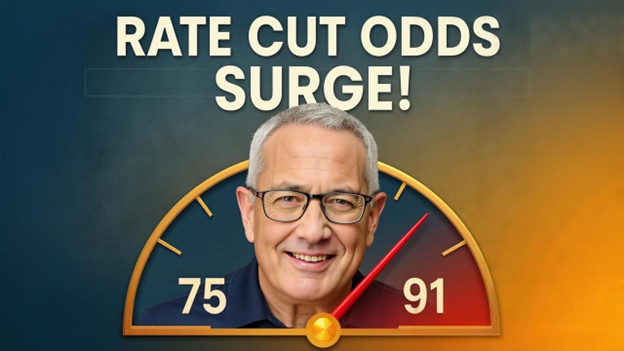
The market’s reaction was immediate and forceful. Probabilities for a 25-basis-point rate cut at the September FOMC meeting, which had dipped to near 70% earlier in the week, surged to almost 90%. This repricing of monetary policy expectations ignited a powerful rally across risk assets. The Dow Jones Industrial Average soared over 850 points to its first record close of 2025, while the S&P 500 erased its weekly losses in a single day. The speech effectively resurrected the “Powell Put,” reassuring investors that the central bank stands ready to support the economy, thereby setting a new, more optimistic tone for the weeks ahead.
U.S. Stock Market Recap: A Tale of Two Tapes
The week’s trading action revealed a significant rotation beneath the surface of the headline index numbers. While the broad market finished modestly higher, this outcome was the product of a powerful divergence between different market segments. The key narrative was a decisive shift out of the high-flying, growth-oriented technology stocks that have dominated market leadership for months and into more cyclical, value-oriented, and interest-rate-sensitive areas. This rotation underscores a change in investor calculus, prioritizing companies poised to benefit from lower borrowing costs and a resilient domestic economy over those valued on long-duration future earnings.
Major Index Performance: Small Caps Lead, Tech Lags
The performance disparity among the major U.S. equity indices this week was stark, perfectly illustrating the market’s reaction to shifting interest rate expectations. Small-capitalization stocks, which are highly sensitive to domestic economic conditions and borrowing costs, dramatically outperformed, while the technology-heavy NASDAQ 100 lagged significantly.
SPDR S&P 500 ETF (SPY): This exchange-traded fund tracks the S&P 500 Index, which represents 500 of the largest U.S. companies weighted by market capitalization. The SPY concluded the week with a modest gain of 0.29%. This seemingly placid result conceals considerable intra-week volatility, as the index fell for five consecutive sessions before Friday’s powerful, Powell-induced rally reversed the entire week’s losses. This price action highlights the market’s extreme sensitivity to Federal Reserve policy signals.
Invesco QQQ Trust (QQQ): This ETF tracks the NASDAQ 100 Index, which comprises the 100 largest non-financial companies listed on the NASDAQ stock exchange. The QQQ finished the week in negative territory, falling by 0.93%. This notable underperformance was driven by a confluence of factors, including profit-taking in mega-cap technology names after a prolonged period of outperformance, rising concerns about competition in the artificial intelligence space, and negative stock-specific news flow affecting key index components.
iShares Russell 2000 ETF (IWM): This ETF tracks the Russell 2000 Index, which is composed of 2,000 small-cap U.S. companies. The IWM was the week’s undisputed leader, surging by 3.39%. This rally was a direct and immediate reaction to Chair Powell’s dovish pivot. Small-cap firms are typically more domestically focused and carry higher debt loads relative to their larger counterparts, making them primary beneficiaries of a lower interest rate environment that reduces borrowing costs and supports domestic economic activity.
S&P 500 Sector Performance: Cyclicals and Rate-Sensitive Groups Roar Back
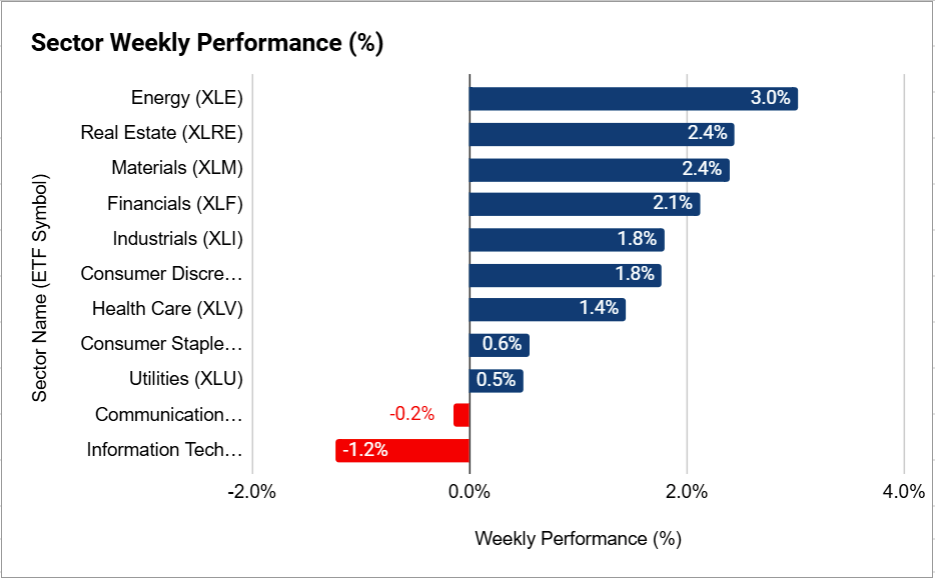
The rotation dynamic was even more pronounced at the sector level. The prospect of lower interest rates and a potential economic soft landing catalyzed strong inflows into cyclical and rate-sensitive sectors, which had lagged for much of the year. Conversely, the technology sector, the market’s erstwhile leader, bore the brunt of the week’s selling pressure.
Best Performers: The Energy sector (XLE) was the top performer, gaining 2.63% for the week. This strength was underpinned by a more than 2% rise in West Texas Intermediate (WTI) crude oil futures, which were supported by a larger-than-expected drawdown in U.S. crude inventories and an increase in the geopolitical risk premium amid stalled Ukraine peace talks. The Real Estate (XLRE) and Utilities (XLU) sectors also posted substantial gains of 2.58% and over 2% respectively. As high-dividend-yielding sectors, they become more attractive to investors when Treasury bond yields fall, as they did following Powell’s speech. The Consumer Discretionary sector (XLY) was a standout performer on Friday, rallying nearly 3% on hopes that lower borrowing costs would bolster consumer spending. Homebuilders and travel-related stocks were notable leaders within the sector.
Worst Performers: The Information Technology sector (XLK) was the week’s worst performer, declining by 0.75%. The sector was weighed down by its most extensive constituents as investors took profits after a long period of outperformance. Headwinds also included concerns that tariffs could raise input costs, a factor highlighted in the August flash PMI report, and negative stock-specific news. Communication Services (XLC) also lagged, falling 0.23%, similarly dragged down by its mega-cap components.
Top 5 S&P 500 Gainers & Losers of the Week
Idiosyncratic factors, primarily related to corporate earnings and strategic announcements, drove some of the most extreme individual stock movements across the S&P 500.
Top 5 Weekly S&P 500 Gainers
The week’s top gainers were concentrated mainly in sectors poised to benefit from lower interest rates, such as solar energy, housing, and travel, which all rallied sharply following Fed Chair Powell’s dovish remarks.
- Enphase Energy (ENPH): A global energy technology company that supplies microinverter-based solar and battery systems. Shares soared 10.4% on Friday, leading the S&P 500, as the entire solar sector rallied on hopes that lower interest rates would reduce financing costs for new projects. The gains were also supported by less restrictive-than-feared guidance from the Treasury Department on clean energy tax credits and a new safe harbor agreement announced by the company on August 19.
- Mohawk Industries (MHK): A global flooring manufacturer with a diversified product portfolio that includes carpets, rugs, ceramic tile, and vinyl flooring. The stock jumped over 7% on Friday as part of a rally in housing-related names. Investors anticipated that lower mortgage rates, following the Fed’s signal, could accelerate growth in the housing market. The company recently beat Q2 earnings expectations and announced a new $500 million share repurchase authorization.
- Norwegian Cruise Line Holdings (NCLH): A leading global cruise company that operates the Norwegian Cruise Line, Oceania Cruises, and Regent Seven Seas Cruises brands, targeting various market segments. Shares advanced as part of a broader rally in the travel industry. The prospect of lower borrowing costs fueled investor optimism that consumers would increase discretionary spending. The company recently delivered record second-quarter revenue and reaffirmed its full-year guidance.
- Caesars Entertainment (CZR): A major U.S. gaming and hospitality company that owns and operates a large portfolio of destinations under brands like Caesars, Harrah’s, and Horseshoe. The stock rallied with other consumer-dependent names after Fed Chair Powell’s comments ignited hopes for an earlier-than-expected interest rate cut, which could boost consumer spending on leisure and travel.
- Carnival Corporation & plc (CCL): The world’s largest leisure travel company, operating a portfolio of nine cruise line brands that cater to a wide range of customer demographics. Similar to its peers, Carnival’s stock gained over 6.9% on Friday amid expectations that a more accommodative Fed policy would support consumer discretionary spending and benefit the travel industry.
Top 5 Weekly S&P 500 Losers
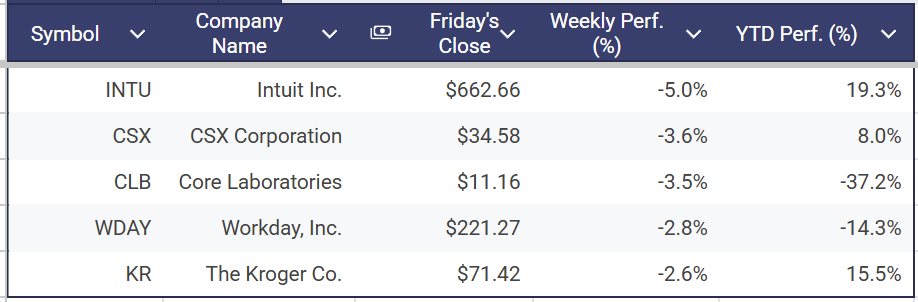
The week’s biggest losers were primarily companies that disappointed investors with their forward-looking guidance, signaling potential headwinds despite some reporting strong quarterly results.
- Intuit Inc. (INTU): A financial software company known for products like TurboTax, QuickBooks, and Mailchimp, which operates on an AI-driven expert platform model. The stock was the S&P 500’s worst performer on Friday, tumbling 5% after providing a weaker-than-expected outlook for the current quarter and full year. The company cited soft demand for its Mailchimp platform and lower revenue per user from TurboTax, which overshadowed a strong fourth-quarter earnings report.
- CSX Corporation (CSX): A leading U.S. transportation supplier providing rail-based freight and intermodal services across a 20,000-mile network in the Eastern United States. Shares fell 3.6% on Friday after the company announced a new coast-to-coast intermodal partnership with BNSF. The move comes as the company faces pressure from an activist investor to explore a merger, particularly after a similar deal was announced between rivals Union Pacific and Norfolk Southern.
- Core Laboratories (CLB): A provider of reservoir description and production enhancement services to the oil and gas industry. The stock has been under pressure since its last earnings report. While Q2 earnings beat estimates, the company’s Reservoir Description segment underperformed due to geopolitical conflicts and tariffs that created volatility in commodity prices, weighing on the stock.
- Workday, Inc. (WDAY): An enterprise cloud application provider specializing in financial and human capital management solutions, primarily through a subscription-based model. The stock fell nearly 3% on Friday after its earnings report. Although the company beat second-quarter revenue and earnings expectations, its guidance for the third quarter came in below consensus forecasts, with management citing a “difficult selling environment” for software.
- The Kroger Co. (KR): One of the nation’s largest grocery retailers, operating over 2,700 stores under various banners, along with fuel centers and pharmacies. The stock’s decline this week lacked a clear, company-specific catalyst. However, on August 20, J.P. Morgan downgraded the stock to a “Hold” rating, which may have contributed to the negative performance.
ValueAligned Portfolio (VAP) Weekly Review
The ValueAligned Portfolio delivered a strong absolute and relative performance for the week, navigating the market’s rotational dynamics effectively. The portfolio’s diversification beyond the mega-cap technology space proved beneficial, as strength in healthcare, consulting, and cyclical holdings more than offset the weakness from its semiconductor and large-cap software positions.
VAP Performance Summary
For the week ending August 22, 2025, the ValueAligned Portfolio generated a total return of 1.24%. This performance represents significant outperformance relative to the S&P 500 ETF (SPY), which gained 0.29%, and the NASDAQ 100 ETF (QQQ), which fell 0.93%. While the portfolio lagged the small-cap-focused Russell 2000 ETF (IWM), which surged 3.39%, its robust return during a week of significant market rotation highlights the strength of its underlying stock selection. The portfolio’s positive attribution came from idiosyncratic catalysts in its healthcare holdings and a beneficial exposure to cyclical stocks that rallied on the Fed’s dovish pivot. This success was achieved despite a notable drag from its holdings in the Information Technology sector, which constituted all five of its worst weekly performers.
VAP Top 5 Weekly Performers
The portfolio’s leading contributors for the week were driven by powerful company-specific news flow, including regulatory approvals, strategic acquisitions, and positive industry trends that allowed them to outperform their respective sectors.
- Novo Nordisk A/S (NVO): A global healthcare company engaged in the discovery, development, manufacturing, and marketing of pharmaceutical products, best known for its leadership in diabetes and obesity care. The stock was the portfolio’s top performer, surging after the U.S. Food and Drug Administration (FDA) approved its blockbuster weight-loss drug, Wegovy, for an additional indication: the treatment of noncirrhotic metabolic dysfunction-associated steatohepatitis (MASH), a form of liver disease. This approval significantly expands the drug’s addressable market. Concurrently, the company announced it was lowering the cost of Wegovy and Ozempic for self-paying patients to $499 per month, a strategic move to defend market share against compounding pharmacies.
- Accenture plc (ACN): A global professional services company providing a broad range of services in strategy, consulting, digital, technology, and operations. Shares advanced after the company announced on August 18 the acquisition of The Highlands Consulting Group. This strategic move deepens Accenture’s relationships with key California state government agencies. It expands its expertise in high-demand areas like healthcare, transportation, and organizational change management, signaling a commitment to growth in the public sector services market.
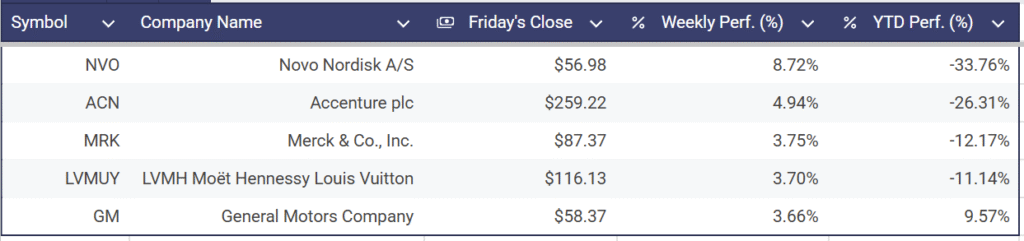
- Merck & Co., Inc. (MRK): A global healthcare company that develops, manufactures, and markets pharmaceuticals and vaccines. The stock performed well following an announcement on August 18 that its investigational drug, ifinatamab deruxtecan, was granted Breakthrough Therapy Designation by the FDA for patients with pretreated extensive-stage small cell lung cancer. This regulatory milestone highlights the potential of Merck’s oncology pipeline and was received positively by investors.
- LVMH Moët Hennessy Louis Vuitton (LVMUY): A multinational conglomerate specializing in luxury goods, with a portfolio of brands across fashion, jewelry, perfumes, and spirits. The stock’s advance was part of the broader market rotation into cyclical and value-oriented names that benefit from positive economic sentiment. The rally was also supported by a report from the Financial Times highlighting a first look at a new makeup line from Louis Vuitton, indicating a potentially lucrative product expansion for its flagship brand.
- General Motors Company (GM): A global automotive company that designs, manufactures, and sells cars, trucks, and automobile parts. GM shares rallied strongly with other cyclical stocks following the dovish Fed signal, as lower interest rates are perceived as a direct tailwind for auto sales. The stock’s performance was also supported by ongoing investor focus on the company’s progress toward EV profitability and a new multiyear steel supply deal with Cleveland-Cliffs.
VAP Bottom 5 Weekly Performers
The portfolio’s five worst-performing stocks were all concentrated in the Information Technology sector, specifically in semiconductors and mega-cap software. These stocks were caught in the broader sector rotation and profit-taking that characterized the week’s trading.
- Advanced Micro Devices, Inc. (AMD): A global semiconductor company that develops computer processors and related technologies for business and consumer markets. AMD was a primary victim of the sell-off in high-growth technology stocks. Despite a fundamentally strong position in the data center and AI markets, the stock’s significant year-to-date gains made it a prime candidate for profit-taking as investors rotated into more beaten-down cyclical areas.
- Broadcom Inc. (AVGO): A global technology company that designs, develops, and supplies a broad range of semiconductor and infrastructure software solutions. Similar to AMD, Broadcom was caught in the semiconductor downdraft. This pullback occurred despite the company having recently reported record quarterly revenue driven by strong momentum in AI solutions and its VMware software segment, indicating the selling was sector-based rather than company-specific.
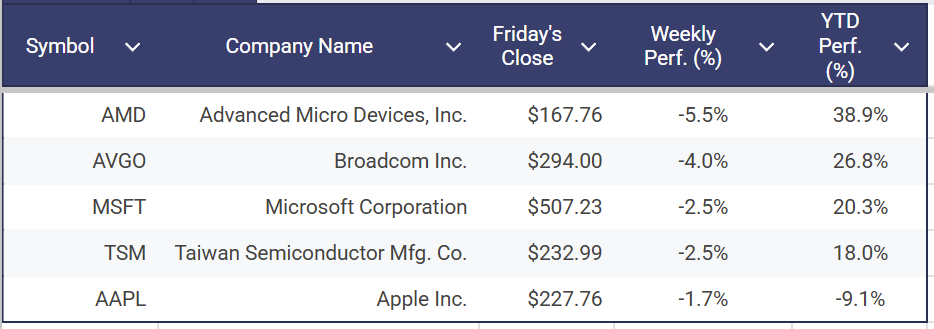
- Microsoft Corporation (MSFT): A multinational technology corporation that develops, manufactures, licenses, supports, and sells computer software, consumer electronics, and personal computers. As one of the market’s largest companies, Microsoft was a major source of funds for the rotation into other sectors. The decline occurred despite positive company news, including an expanded partnership with the NFL to integrate its Copilot AI technology, suggesting the stock’s movement was driven by macro flows rather than fundamental developments.
- Taiwan Semiconductor Manufacturing Co. (TSM): The world’s largest dedicated independent semiconductor foundry, manufacturing chips for a global client base. TSM was explicitly cited as a market laggard during the week, with its shares sliding 3.8% at one point. The stock was pressured by the global tech sell-off and persistent investor concerns over how geopolitical tensions between the U.S. and China could impact the critical semiconductor supply chain.
- Apple Inc. (AAPL): A multinational technology company that designs, manufactures, and markets smartphones, personal computers, tablets, and wearables. Apple shares declined in line with the broader technology sector. With no significant negative company-specific news, the stock’s underperformance was a clear result of the market’s rotation away from mega-cap growth stocks and into value and cyclical names.
Economic & Policy Update: The Data Behind the Dovish Shift
The Federal Reserve’s pivot at Jackson Hole was not made in a vacuum. It was informed by a week of mixed but telling economic data that painted a picture of a resilient but subtly softening U.S. economy, giving the central bank the justification to shift its focus toward the labor market. This was set against a backdrop of an active policy environment in Washington, where trade and tariff policies continue to create inflationary crosscurrents.
Key Economic Releases
Economic data released during the week presented a complex picture. While top-line growth indicators remained surprisingly robust, underlying labor market data began to show signs of cooling, providing the crucial evidence needed for the Fed’s change in tone.
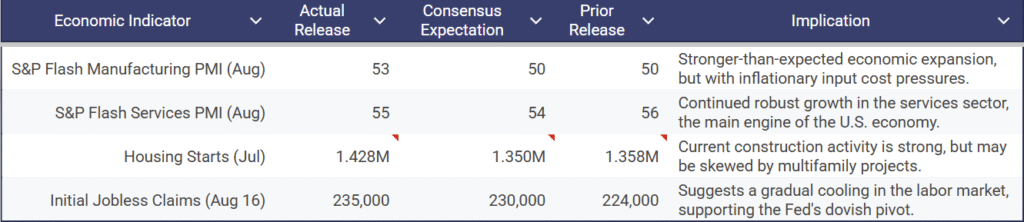
- S&P Flash PMIs (Strong): The most significant upside surprise of the week came from the S&P Global Flash U.S. PMI report. The Manufacturing PMI crushed expectations, registering 53.3 against a forecast of 49.7, moving firmly into expansionary territory (a reading above 50). The Services PMI also beat expectations at 55.4 versus 54.2 expected. The report noted, however, that the rise in input prices could be linked to recently implemented tariffs, an inflationary signal the Fed is watching closely.
- Housing Data (Mixed): The housing market sent conflicting signals. July Housing Starts surged 5.2% to an annual rate of 1.428 million units, well above forecasts, driven primarily by strong demand for multifamily units. However, Building Permits, a forward-looking indicator, fell 2.8%, suggesting a potential slowdown in future construction activity.
- Jobless Claims (Weakening): A critical data point influencing the Fed’s outlook was the weekly report on initial jobless claims. For the week ending August 16, claims rose to 235,000, slightly above the consensus forecast of 230,000 and an increase from the prior week. While still at historically low levels, this steady upward creep in claims provided tangible evidence of the modest labor market softening that Chair Powell highlighted in his speech.
Washington & The Fed: From Hawkish Minutes to a Jackson Hole Pivot
The week’s policy narrative was a study in contrasts. It began with a look back at the Fed’s more hawkish stance in July and ended with a distinctly more cautious and forward-looking message from its leader.
- FOMC Minutes (July 29-30 Meeting): The minutes from the Fed’s July meeting, released on Wednesday, August 20, were perceived by the market as stale but still influential. They reflected a committee still highly focused on inflation risks, with some members expressing concern that policy was not yet restrictive enough. This release temporarily dampened expectations for a September rate cut and contributed to the market’s risk-off tone mid-week.
- Powell’s Jackson Hole Speech: Chair Powell’s speech on Friday effectively superseded the July minutes, offering a more current assessment of the economic landscape. He directly addressed the tension between the Fed’s dual mandates, stating, “In the near term, risks to inflation are tilted to the upside, and risks to employment to the downside—a challenging situation”. By signaling a willingness to “proceed carefully as we consider changes to our policy stance” in the face of rising employment risks, he gave the market its strongest signal yet that a rate cut is on the table for September.
- Washington Policy: The Trump administration’s trade policy remains a significant variable for the economy and markets. The administration announced new tariffs on products containing steel and aluminum, which directly impacts industries like auto manufacturing. This protectionist stance is creating an inflationary impulse that works at cross-purposes with the Federal Reserve’s goals. Chair Powell explicitly acknowledged the impact of tariffs on consumer prices in his speech, noting that their effects are “now clearly visible” and are expected to accumulate in the coming months. This policy conflict—fiscal policy pushing inflation up while monetary policy prepares to ease to support growth—creates a complex and potentially volatile environment for investors.
Geopolitical & Global Market Factors
Beyond domestic policy, a complex geopolitical landscape continued to influence market sentiment and asset prices. Tensions between major global powers are no longer abstract risks but are having tangible impacts on specific sectors and commodity markets.
- U.S.-Russia Summit and the Ukraine War: High-stakes diplomatic engagements between the U.S. and Russia regarding the war in Ukraine were a primary focus for global observers. A summit between President Trump and Russian President Vladimir Putin in Alaska, followed by meetings in Washington with Ukrainian President Volodymyr Zelenskyy and European leaders, failed to produce a definitive ceasefire agreement. This ongoing uncertainty was a key factor contributing to a “geopolitical risk premium” in global oil markets, providing a direct tailwind for crude prices and, consequently, the Energy sector.
- U.S.-China Strategic Competition: The strategic rivalry between the United States and China continues to manifest in the economic and technological spheres. The themes of tariffs, export controls, and technology decoupling remain central risks. A concrete example of this emerged during the week with reports that some suppliers had instructed Nvidia to halt production of its H20 AI chip, a less powerful version designed for the Chinese market. This was reportedly due to a lack of demand, potentially stemming from Beijing’s security concerns and a push for domestic alternatives, highlighting the real-world business impact of this competition on leading U.S. technology firms.
- Global Economic Fragmentation: Broader analyses from international institutions paint a picture of a world facing significant structural shifts. The International Monetary Fund (IMF) projects global growth will remain “steady but slow,” while highlighting risks from renewed inflationary pressures and trade tensions. Geopolitical strategists at firms like Lazard and EY have identified rising trade protectionism, demographic divides, and the fragmentation of global supply chains as key risks for 2025, creating a more complex and uncertain operating environment for multinational corporations.
Outlook for the Week Ahead: Can the Rally Broaden?
Following the dramatic reversal, the key question for the week ahead is whether the market’s newfound optimism can be sustained and whether the rally can continue to broaden beyond its narrow leadership. The focus will shift from Fed rhetoric to complex inflation data and a critical earnings report from the technology sector’s most crucial bellwether.
Upcoming Market Catalysts
The economic calendar for the week of August 25th is back-loaded with crucial data releases that will test the market’s conviction in a forthcoming rate cut. The earnings calendar also features several high-stakes reports.
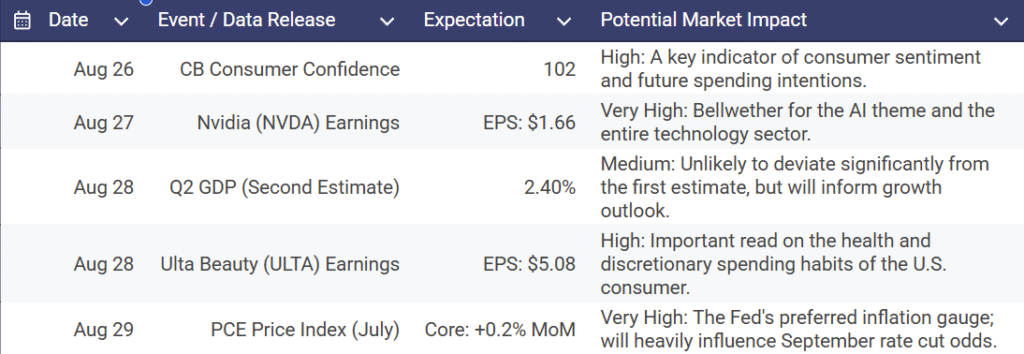
- Economic Data: The main events are the second estimate of Q2 Gross Domestic Product (GDP) on Thursday and, most importantly, the Personal Consumption Expenditures (PCE) Price Index for July on Friday. As the Fed’s preferred measure of inflation, the PCE report will be scrutinized intensely. A cooler-than-expected reading would validate the Fed’s dovish pivot and cement expectations for a September cut. Conversely, a surprisingly hot print could challenge the market’s narrative and reintroduce volatility.
- Key Earnings Reports: A heavy slate of corporate earnings is scheduled. The two most critical reports for the VAP portfolio and the broader market are from Nvidia (NVDA) on Wednesday and Ulta Beauty (ULTA) on Thursday. Nvidia’s results and, more importantly, its forward guidance will serve as a referendum on the entire AI investment theme that has propelled the market higher this year. Ulta’s report will provide a vital read on the health of the U.S. consumer, a key area of focus for the Federal Reserve.
The Bull and Bear Case for Next Week
- The Bull Scenario: The positive momentum from Friday’s rally carries over into the new week. A benign PCE inflation report confirms that price pressures are contained, solidifying market expectations for a September rate cut. This fuels a continued broadening of the market rally, with cyclical, value, and small-cap stocks extending their gains. A strong earnings report and optimistic guidance from Nvidia would reignite the technology sector, leading to a powerful “all-boats-lifted” rally where both old and new market leaders advance.
- The Bear Scenario: The market is viewed as overbought after Friday’s powerful surge, leading to profit-taking early in the week. A hotter-than-expected PCE report spooks investors, forcing them to pare back their aggressive rate cut expectations. This likely causes bond yields to rise and equities to fall, with rate-sensitive sectors giving back their recent gains. Concurrently, a disappointing earnings report or cautious guidance from Nvidia could trigger a significant sell-off in the technology sector, dragging the entire market down and calling the durability of the AI investment thesis into question.
Sectors and Stocks to Watch
- Sectors: The Financials (XLF) and Industrials (XLI) sectors will be closely watched to see if the cyclical rotation that began last week has durability. The Technology (XLK) sector faces its most significant test of the earnings season with Nvidia’s report, which will likely determine the sector’s direction for the coming weeks.
- Stocks: Nvidia (NVDA) is unequivocally the most crucial stock to watch. Its results will have ripple effects not only across the semiconductor industry but also for the entire market, given its role as the primary engine of the 2025 rally. Ulta Beauty (ULTA), a VAP holding, will offer a crucial data point on consumer health. Any signs of weakness in its report or guidance could amplify the concerns about a slowdown in consumer spending that Chair Powell alluded to in his speech, potentially weighing on the broader Consumer Discretionary sector.