

As a financial analyst specializing in a “bottom-up” review of tech earnings, the latest Amazon report reveals strategic moves far more significant than the headline revenue numbers. My analysis of the earnings call and supplementary data points to five key strategic pillars that are often missed by surface-level reporting. These insights show how the company is building an interconnected, self-reinforcing machine for dominance in the next decade.
TL;DR: Key Takeaways from Our Analysis of Amazon’s Financials
|
Insight 1: What Is the True Scale of Amazon’s Long-Term Growth?
Amazon’s long-term value creation has been achieved through a consistent Compound Annual Growth Rate (CAGR) of approximately 29% sustained over 27 years. This level of high-speed growth is exceedingly rare in business history.
To put this into perspective, based on our analysis of its historical stock data:
- 1997 (Dec): Split-adjusted stock price was $0.25.
- 2024 (Dec): The same stock was priced at $222.86.
- Total Increase: An 891.44-fold increase.
This data reveals a core strategy of patient, long-term capital allocation that consistently compounds shareholder value, rather than a focus on short-term quarterly gains.
Insight 2: Why Is AWS’s Growth Rate So Misleading?
The key insight from the latest financial data is that AWS’s growth is not just continuing—it is reaccelerating. It posted a 20.2% year-over-year growth rate, a figure that is often misunderstood without the context of its scale. This acceleration is happening on top of a massive $132 billion annualized revenue run rate.
As CEO, Andy Jassy highlighted, this growth is fundamentally different from competitors:
It’s very different having 20% year-over-year growth on a $132 billion annualized run rate and to have a higher percentage growth rate on a meaningfully smaller annual revenue, which is the case with our competitors.
This isn’t just growth; it’s the widening of a competitive moat. At this scale, a 20.2% growth rate means adding over $20 billion in new annualized revenue in a single year, demonstrating an unmatched velocity in capturing new market demand.

Insight 3: How Is Amazon Building a “Secret” AI Empire?
While public attention focuses on third-party chip makers, Amazon has quietly built a dominant, vertically integrated AI business using its own custom silicon. The company’s Trainium chips are a powerhouse that is already a core part of its strategy.
Our analysis of the earnings data identified these critical figures for the Trainium2 chip business:
- Business Scale: It is now a “multibillion-dollar business.”
- Growth Rate: It experienced 150% quarter-over-quarter revenue growth.
- Demand: It is “fully subscribed,” indicating demand is outpacing supply.
This vertical integration—controlling the custom silicon and the cloud services—provides a compounding cost and performance advantage. This strategy reveals Amazon’s core goal: to own the foundational layers of the entire AI stack.
Insight 4: What Was the Real Motivation for Recent Layoffs?
Contrary to the common assumption that financial considerations drive mass layoffs, Amazon’s leadership presented a surprising, counterintuitive rationale. The decision was framed as a proactive, cultural reset designed to fight bureaucratic decay.
CEO Andy Jassy directly stated the motivation was not financial or AI-driven, but cultural:
“As a leadership team, we are committed to operating like the world’s largest start-up. And that means removing layers. It means increasing people’s ownership and moving quickly.”
This move is a preemptive strike against the corporate sclerosis that plagues most large organizations. It’s a deliberate strategy to ensure Amazon’s massive scale doesn’t destroy its speed and agility.
Insight 5: What Does Amazon’s Investment Scale Reveal About Its Future?
Amazon is investing in its future infrastructure at a rate almost unimaginable, signaling its preparation for a massive surge in demand for AWS and AI services. The company’s full-year cash Capital Expenditures (CapEx) are projected to be approximately $125 billion in 2025 and are expected to increase again in 2026.
The most telling data point relates to its physical capacity:
- 2022: Baseline AWS power capacity.
- 2024: AWS power capacity is double the 2022 level.
- 2027 (Goal): Double the capacity again.
This isn’t a simple investment; it’s a statement of intent to build a utility-scale AI infrastructure. Amazon is positioning AWS to be the foundational, non-negotiable layer of the entire AI economy, operating at a scale orders of magnitude larger than its rivals.
Conclusion: The Amazon Flywheel—A Framework for Dominance
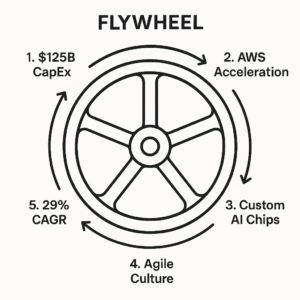
My analysis of these five points reveals they are not isolated facts but components of a single, self-reinforcing operational flywheel. This framework explains how Amazon builds and sustains its dominance.
Here is a step-by-step breakdown of the flywheel:
- Step 1. Massive Infrastructure Investment: The cycle begins with unimaginable CapEx ($125B in 2025) to build utility-scale capacity (Point 5).
- Step 2. Enable Core Engine Growth: This new capacity enables the reacceleration of AWS, its primary economic engine (Point 2).
- Step 3. Fund Proprietary R&D: The profits from AWS are used to fund deep R&D into proprietary advantages, like custom Trainium AI silicon, which creates a cost and performance moat (Point 3).
- Step 4. Reinforce Agile Culture: The entire machine is governed by a deliberately lean, anti-bureaucratic “start-up” culture that ensures agility despite its size (Point 4).
- Step 5. Compound Long-Term Value: This entire system—scale, profit, R&D, and culture—is focused on a single output: patient, long-term compounding returns, as evidenced by its 27-year, 29% CAGR (Point 1).
As Amazon prepares to double its cloud infrastructure yet again, the question for investors, competitors, and analysts isn’t just whether it can keep growing. The real question is: what happens to the rest of the tech landscape when one company operates on a scale orders of magnitude beyond everyone else?