
Weekly Market & ValueAligned Portfolio Review — trading week of June 1–5, 2026
The short version
- The S&P 500 — a list of 500 of the biggest U.S. companies — fell 2.6% last week. Tech stocks fell harder, down 5.6%.
- Almost all the selling hit the biggest tech and AI names. The average stock barely moved: the equal-weight S&P fell just 0.5%.
- Stock Prices dropped, but the businesses did not get worse. This was a mood swing, not a breakdown.
- The new head of the Federal Reserve, Kevin Warsh, argues that AI is making workers more productive — which, in his view, could allow the Fed to cut interest rates.
- Our portfolio fell 3.8% after fees last week. For the past 12 months, it has been up 25.3% after fees.
What happened, in plain words
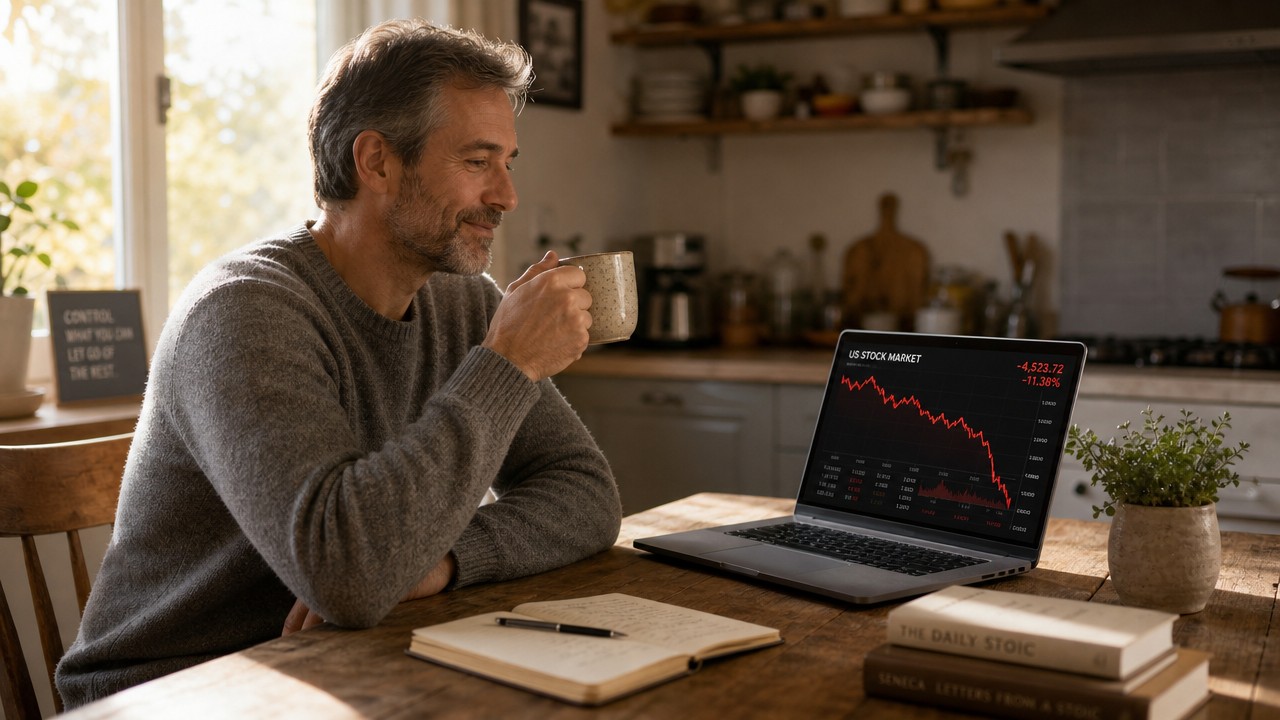
The S&P 500 fell 2.6% last week. Tech stocks dropped 5.6%. Our ValueAligned Portfolio was down 3.8% after fees. A week like that can turn your stomach.
Here is the part that matters most. The companies we own did not get worse. Their stock prices went down. The businesses stayed strong.
I am a guide here, not a guru. I will not tell you what to do with your money. I will show you how I think through a week like this, and you can take what is useful for you.
The selling was narrow, not wide
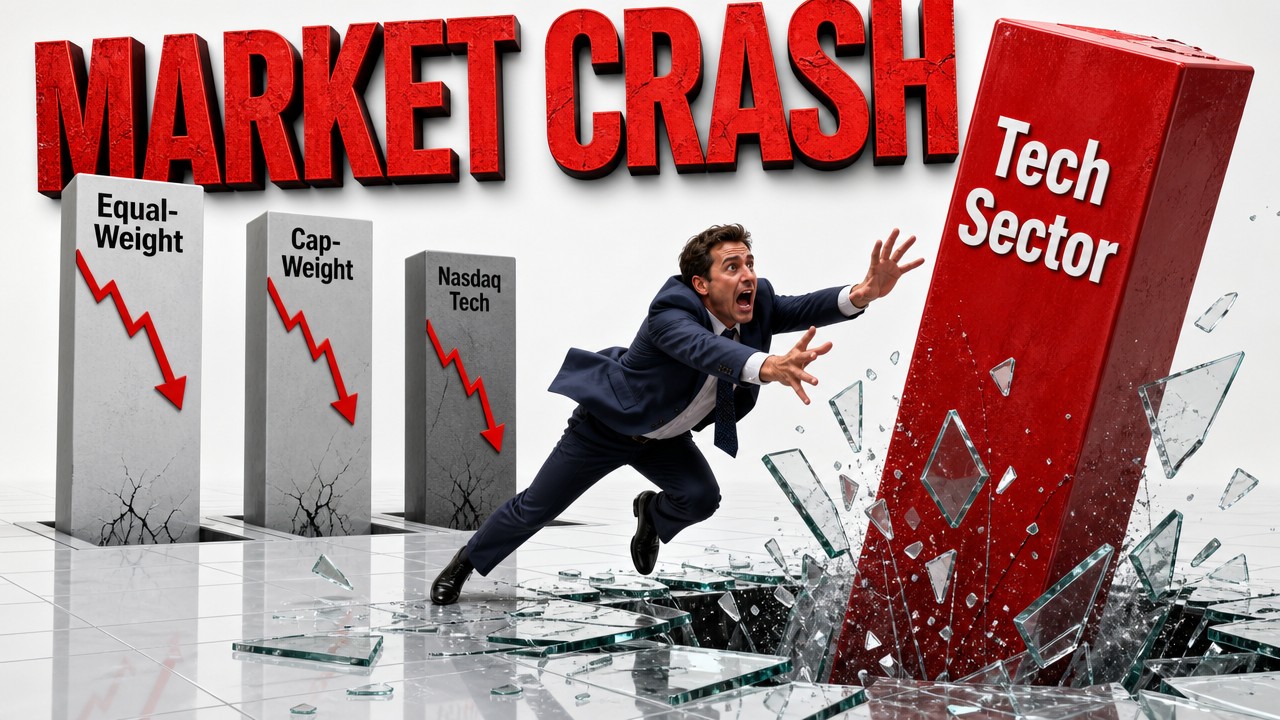
Almost all of the drop hit one corner of the market: AI companies and the biggest tech names. The rest of the market barely moved.
There are two ways to measure a group of stocks. A cap-weighted index counts the biggest companies the most, so when a few giants fall, the whole index looks like it fell hard. An equal-weight index counts every company the same, big or small. The gap between the two tells you who really got hit.
| What it tracks | Fund (ticker) | Last week |
|---|---|---|
| Every stock counted equally | Equal-weight S&P (RSP) | -0.5% |
| The biggest companies count the most | Cap-weight S&P (SPY) | -2.5% |
| Big tech / Nasdaq 100 | Nasdaq tech fund (QQQ) | -4.5% |
| Technology sector | Tech sector fund (XLK) | -5.6% |
Read that spread. The typical stock had a quiet, normal week. Only the very biggest stocks had a rough one. That is not a broken market. That is a few giants taking a breather.
Money did not leave the market, either. It moved around inside it. That shift is called sector rotation — investors moving cash from one part of the market to another. Last week, the winners were energy (+2.5%), healthcare (+2.4%), real estate (+1.6%), and financials (+1.4%). The losers were technology (-5.6%), consumer discretionary (-5%), and communications (-3.5%). Consumer discretionary refers to companies that sell goods and services people want but do not truly need, such as cars, restaurants, and vacations.
Stock prices fell. The fundamentals did not.
Fundamentals are the real health of a business: how much it sells, how much it earns, how fast it grows. None of that got worse last week. What changed was the mood. Investors got nervous and sold. Call it a sentiment event — a fancy way of saying a mood swing, not a sign the companies are breaking.
Remember where these stocks came from. Going into the week, AMD was up 117% for the year. Semiconductor stocks — the companies that make computer chips — were up 58%. Tech overall was up 25%. When prices climb that fast, people lock in profits. Even after the drop, chip stocks are still up 58% for the year. That looks like profit-taking, not a change in the long-term trend.
Why I think prices may keep cooling
Inflation is the rate at which everyday prices rise. We measure it with the Consumer Price Index, or CPI.
What is the CPI? Picture a basket of common things a family buys — food, gas, rent, clothes. The government tracks how the price of that basket changes over time. That is the CPI. Core CPI sits near 2.8% right now, and I expect it to keep falling this year.
Here is why prices are cooling. Productivity is rising. Productivity is how much a worker can make in one hour. When a worker, helped by better tools and now by AI, can make more in the same hour, companies can pay people more without raising prices. Wages grew just 0.3% for the month — steady, not hot. Stores like Walmart and Costco are using that efficiency to hold prices down instead of passing increases on to you.
Two investors I respect see the same picture. Cathie Wood, who runs ARK Invest, argues the bigger risk is deflation, not inflation, because technology keeps pushing costs down. Ron Baron, who runs Baron Capital, makes a similar case: AI and robots drive economic growth even as inflation cools.
Is this a bubble like the dot-com crash?
Fair worry. Ron Baron makes the case that it is not, and the numbers back him up.
In the dot-com era around the year 2000, companies spent 5% to 6% of the whole economy building out technology. Today, spending on AI is only about 2% of the economy. A quick term: CapEx stands for capital expenditure, which is the money a company spends on big, long-term assets like buildings, machines, and computers.
Now look at the size of the prize. All of technology is about $5 trillion of a $110 trillion global economy. Human labor is 45% to 50% of it. Goldman Sachs estimates the 500 largest U.S. companies could save hundreds of billions of dollars a year from AI by 2030, and AI builders are set to spend more than $500 billion in 2026 alone. This looks like the early part of a new industrial revolution, not the end of one.
A new Fed chair who thinks differently
The Federal Reserve, often just called the Fed, is the central bank of the United States. Its main job is to set interest rates, which control how cheap or costly it is to borrow money. The new head of the Fed is Kevin Warsh, who was sworn in as chair in May 2026, and he thinks differently from his predecessors.
There is an old idea in economics called the Phillips curve. It says that when lots of people have jobs, prices must go up. Warsh rejects that idea. He believes that if workers keep getting more productive, the economy can run hot and inflation can still fall. Because of that, he may cut interest rates even while the economy is booming. Lower rates tend to help stocks, especially fast-growing companies.
Here is a telling sign. The price of gold peaked the very day Warsh was appointed. Gold usually rises when people fear inflation. It started falling the moment a man known for fighting inflation took the job.
Put the pieces together, and you get what investors call a Goldilocks setup — an economy that is not too hot and not too cold, but just right. The latest jobs report showed 172,000 new jobs, far more than the 88,000 people expected. Those are called payrolls, which are simply counts of how many jobs employers added. Wages rose a steady 0.3%. Strong jobs, calm wages, cooling inflation. That is a healthy backdrop for the businesses we own.
Why AI demand is not slowing down
Demand for AI computing continues to grow across three areas. First, pre-training, which means building bigger and smarter AI models. Second, post-training, which means teaching those models to get better through practice. Third, test-time compute, which means letting the AI think for longer before it answers. Every one of these needs more computing power.
A quick word. Compute just means raw computing horsepower, and the chips that do most of that work are called GPUs, short for graphics processing units. The most demanding new AI model, called Grok 4, was trained on a cluster of more than 200,000 of Nvidia’s GPUs. And Nvidia’s CEO says every gigawatt of new AI data-center power turns into $40 to $50 billion of orders for his company. A gigawatt is just a measure of the electricity those giant data centers use. This build-out is still in its early innings.
The story keeps widening beyond chips. Three examples we are watching: Arista Networks builds the plumbing that connects all those chips, and the industry is shifting toward its networking style. Shopify is moving into what people call agentic commerce, where an AI assistant shops and places orders for you. And Tesla’s Optimus is a human-shaped robot built to do real physical work. Each one is a different door into the same trend — machines doing more of the heavy lifting so people can do more.
How our portfolio did — the good and the bad
I will give it to you straight. For the week, we were down 3.7% before fees and 3.8% after. The S&P 500 was down 2.6%, so we trailed the market this week.
Two terms you will see. Gross means before we take out our fee. Net means after the fee — the number you actually keep. And YTD means year-to-date, or how much something has done since January 1. For the year, we are up 3% after fees. Over the past 12 months, we are up 25.3% after fees.
Our best holding last week was AutoZone, the auto-parts retailer, up 6.2%. Our worst was Broadcom, a chip and networking company, down 13.7%. I show you both on purpose. A client asked me last week why I name our losers out loud. The answer is simple: you cannot trust someone who only shows you the wins.
One honest risk worth naming. AMD is close to 10% of our portfolio, so a single AI stock can swing our results. We watch that closely.
What could happen next?
The big test is the next inflation report, due June 10.
The bull case — the hopeful path: oil prices fall, inflation keeps cooling, Warsh signals rate cuts, and the AI leaders pick back up where they left off.
The bear case — the path that would hurt: the AI sell-off spreads wider, weakness in software companies grows, Warsh stays patient and holds rates steady, and our portfolio keeps lagging for a while.
I will not pretend I know which one wins in the short run.
Step back from one rough week, and here is where I land. I believe our thinking is stronger than it was seven days ago. We own companies building what looks like the next industrial revolution, and owning those means sitting calmly through weeks like this one. A client called me on Friday, worried, with her finger over the sell button. We walked through these same numbers together. By the end of the call, she felt steady again. That is the whole job.
Key takeaways
- The drop hit mostly mega-cap tech and AI stocks. The equal-weight S&P fell just 0.5%, so the typical stock had a normal week.
- Stock prices fell, but business fundamentals did not. This was a mood swing after huge gains earlier in the year.
- Rising productivity, a possible cooling in inflation, and a Fed chair open to cutting rates would make a friendly backdrop — though that path is far from certain.
- Our portfolio trailed the market last week (-3.8% after fees) but is up 25.3% over 12 months. AMD’s near-10% weight is the risk we watch.
- The next inflation report on June 10 is the near-term swing factor.
Endnotes
- The average stock barely moved – How an equal-weight S&P 500 fund (RSP) differs from a cap-weighted one (SPY), and why the gap matters. https://drwealth.com/rsp-vs-spy/
- argues AI is making workers more productive – Analysis of new Fed Chair Kevin Warsh’s supply-side view that AI-driven productivity could allow rate cuts. https://equitablegrowth.org/what-is-the-relationship-between-inflation-interest-rates-and-economic-growth-and-what-does-it-mean-for-the-new-federal-reserve-chair/
- tracks how the price of that basket changes over time – U.S. Bureau of Labor Statistics explainer on what the Consumer Price Index measures. https://www.bls.gov/cpi/questions-and-answers.htm
- argues the bigger risk is deflation, not inflation – ARK Invest’s Cathie Wood on her long-standing thesis that technology-driven productivity makes deflation, not inflation, the real risk (May 2026 In The Know). https://www.ark-invest.com/videos/market-commentary/may-2026-in-the-know-cathie-wood
- AI builders are set to spend more than $500 billion in 2026 – Goldman Sachs research on the scale of AI capital spending and its productivity potential. https://www.goldmansachs.com/insights/articles/why-ai-companies-may-invest-more-than-500-billion-in-2026
- sworn in as chair in May 2026 – CBS News report on Kevin Warsh becoming Federal Reserve chair and the debate over rate cuts. https://www.cbsnews.com/news/kevin-warsh-federal-reserve-chair-interest-rates/
- Phillips curve – Brookings Institution explainer on the Phillips curve – the idea linking low unemployment to higher inflation. https://www.brookings.edu/articles/the-hutchins-center-explains-the-phillips-curve/
- trained on a cluster of more than 200,000 of Nvidia’s GPUs – xAI’s announcement of Grok 4, trained on its 200,000-GPU Colossus supercomputer. https://x.ai/news/grok-4
- Every gigawatt of new AI data-center power turns into $40 to $50 billion of orders – Nvidia CEO Jensen Huang’s estimate of company revenue per gigawatt of AI data-center capacity. https://finance.yahoo.com/news/nvidias-jensen-math-50-billion-033104538.html
Disclosure
This article is for educational and entertainment purposes only. Nothing here is investment advice, tax advice, legal advice, or accounting advice. I am not your CPA, accountant, attorney, or tax professional, and I am not acting as your financial advisor in this article.
Investing involves risk, including loss of principal. Past performance does not predict future results. Markets, tax law, and individual circumstances change. Before acting on anything you read here, consult a qualified professional who knows your full situation.
Position disclosure: I, members of my family, and clients of VAP Wealth Advisors may own positions in the security or securities discussed in this article. I may buy, sell, add to, or trim those positions at any time without prior notice and without updating this article. Nothing said here should be taken as a recommendation to buy, sell, or hold any specific security.
Views expressed are my own and do not necessarily reflect the views of VAP Wealth Advisors.
Regulatory Information
ValueAligned Partners LLC is a Registered Investment Advisor. For additional information, please refer to our Form ADV, available on the SEC’s website at www.adviserinfo.sec.gov.