
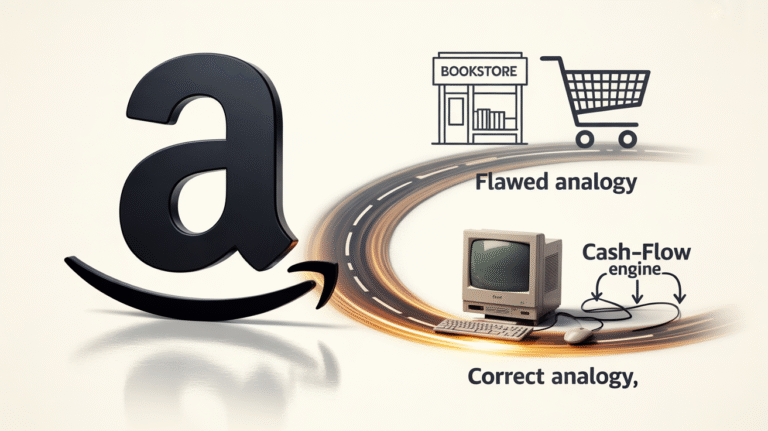
The Dell-Amazon Insight
- The Quick Answer: Legendary investor Bill Miller gained the conviction to bet heavily on Amazon (AMZN) by realizing its business model was identical to Dell Computer’s, not a traditional retailer like Barnes & Noble or Walmart.
- The “Secret” Model: In the 1990s, Dell pioneered a revolutionary model with a negative cash conversion cycle. It collected cash from customers immediately but paid its suppliers 30-60 days later. This generated a 100% return on invested capital (ROIC) and allowed Dell to fund its own explosive growth using customer cash—a “float.”
- The Amazon Connection: When Miller asked Jeff Bezos to describe his business model, Bezos replied, “It’s Dell.” Miller instantly understood that Amazon was building the same capital-light, cash-flow engine.
- The Key Lesson: The market’s most profitable insights come from understanding a company’s underlying financial engine, not from relying on superficial analogies (like “online bookseller”) or conventional metrics (like P/E ratios).
In my 30 years of investment management, I’ve seen one battle play out repeatedly: the battle between timeless principles and the noise of conventional wisdom. The market’s favorite rules of thumb can provide comfort, but they often blind investors to revolutionary changes.
Few navigated this better than Bill Miller. His experience with a “boring” PC company in the 1990s gave him the conviction to bet on Amazon before almost anyone understood its true potential. The answer reveals a powerful lesson in seeing what others miss.
Why Do Conventional Metrics Blind Investors?
The Question: Why do popular metrics like the Price-to-Earnings (P/E) ratio so often cause investors to miss significant opportunities?
The Direct Answer: Conventional metrics fail because they are rigid, backward-looking rules of thumb. They create a “factor-based accounting methodology” that completely misses revolutionary shifts in a business’s underlying engine. Investors become so focused on the label (e.g., “a 12x P/E stock”) that they fail to analyze the machine itself.
Concrete Takeaway: The Dell Case
- The Old Rule: In the 1990s, the playbook for PC stocks was simple: “You buy them at six times earnings and you sell them at twelve times earnings.”
- The Market’s Move: When Bill Miller invested in Dell around 1993-94, the stock soon hit 12x earnings. As Miller noted, this was the point when “everybody bailed out of Hewlett-Packard and Gateway and Dell.”
- Miller’s Insight: Miller did something radical: he held on. He held as Dell climbed to 45x earnings and grew to 25% of his portfolio. His peers thought he had “lost his mind.”
- From My Perspective: What his peers saw as recklessness was a profound philosophical shift. Miller had stopped looking at the price tag and started analyzing the “guts of the business.” This is the core of true value investing—understanding the source of the cash flow, not just its current multiple.
Critical Insight: The most significant investment opportunities often lie in questioning the dominant market narrative and the metrics used to justify it.
What Was Dell’s Revolutionary “100% ROIC” Model?
The Question: What did Bill Miller find inside Dell’s business that justified a 45x P/E valuation?
The Direct Answer: Miller discovered that Dell was “the very first company ever to generate 100% return on invested capital” in modern history. It achieved this through a masterclass in cash flow management, enabling it to grow at 15-20% per year with zero outside capital.
A Step-by-Step Breakdown of Dell’s Cash-Flow Engine:
- Order & Payment: A customer called Dell’s 1-800 number to order a custom PC. They were told it would ship in 2-3 weeks and provided their credit card details upfront.

- Cash Received: That cash was in Dell’s bank account the very same night.
- Supplier Payment: Dell, however, didn’t have to pay its suppliers (such as Intel or Microsoft) for components for another 30 to 60 days.
This gap between receiving payment and paying out is a negative cash conversion cycle. Dell was essentially using its suppliers’ and customers’ money (a “float”) to fund its operations and growth. As long as orders kept coming, it required no new capital to expand.
Critical Insight: A business that funds its own growth is fundamentally different and infinitely more valuable than its competitors. Miller calculated that a company growing 15-20% annually with 100% ROIC was worth far more than 45x earnings, a valuation that seemed absurd to everyone stuck in the old P/E framework.
How the Correct Analogy Unlocked Amazon’s Future
The Question: How did this deep understanding of Dell lead Bill Miller to make a “huge bet” on Amazon in 1999, right before the tech crash?
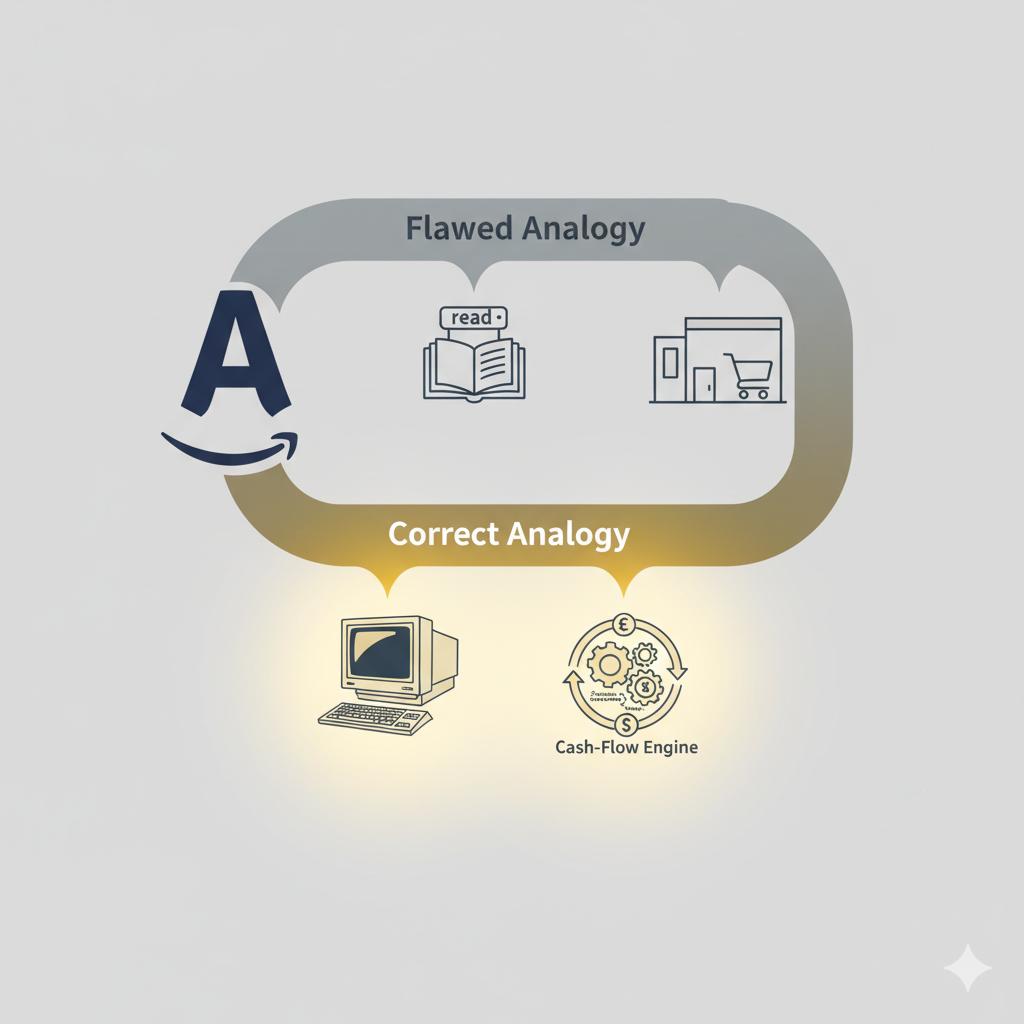
The Direct Answer: It provided him with the correct analogy. While the market was fumbling with flawed comparisons for Amazon, Miller’s Dell framework allowed him to see the actual financial engine Jeff Bezos was building.
When Miller’s team met with Bezos, they cut through the noise with one question: “What’s the business model?”
Bezos’s two-word answer was the key: “It’s Dell.”
For Miller, that was the only signal he needed. He was “home free.” He knew exactly what was going to happen.
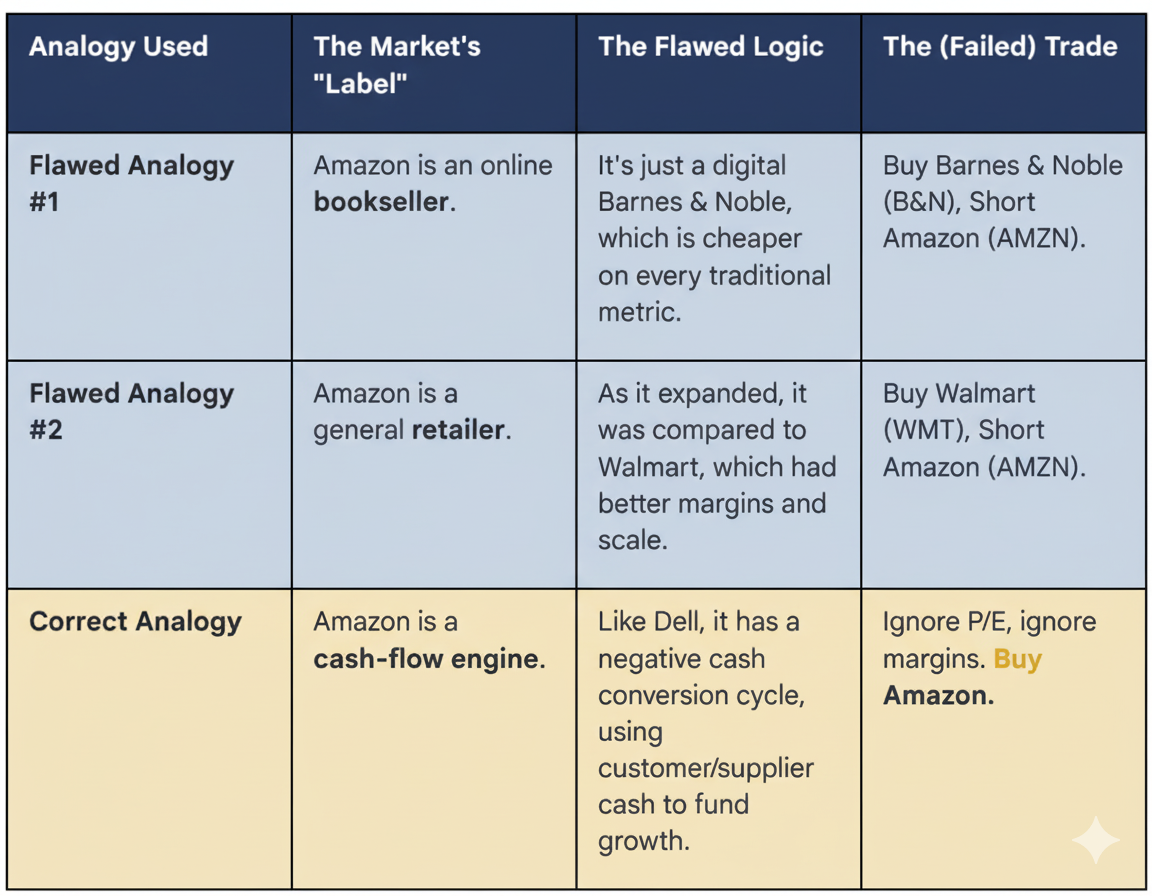
Structured Evidence: Flawed Analogies vs. The Correct Analogy
Critical Insight: The world was describing Amazon as Barnes & Noble and Walmart. Bill described it as a Dell. While everyone else saw a low-margin retailer (the label), Miller saw a capital-light, self-funding growth machine (the engine). This correct analogy, born from his deep analysis of Dell, gave him the conviction to make a legendary investment.
Conclusion: Are You Looking at the Label or the Engine?
Bill Miller’s story is a powerful reminder that the greatest investment insights don’t come from accepting superficial comparisons. They come from doing the hard work of understanding a company’s underlying mechanics.
In my own ValueAligned Investing framework, we focus on this exact principle: identifying great companies with durable competitive advantages (a “moat”) that are trading below their intrinsic value. Often, that moat isn’t a brand; it’s a superior financial architecture, just like Dell’s and Amazon’s.
To apply this lesson, stop asking “What is this company’s P/E ratio?” and start asking, “What is this company’s engine?”
A Framework for Finding the “Engine”
Here is a simple, 3-step process to start looking for the real engine, based on the lessons from Miller, Dell, and Amazon.
- Question Conventional Metrics: If a company looks “expensive” on a P/E or “cheap” on a P/B (Price-to-Book) basis, ask why. Is the market missing a fundamental shift in the business model, or are you?
- Map the Cash Conversion Cycle: This is the most critical step. Ask:
- When does the company get paid by its customers? (e.g., at checkout)
- When does the company pay its suppliers? (e.g., 30, 60, or 90 days later)
- How long does it hold inventory?
- A business that gets paid before it pays its bills (a negative cash conversion cycle) is a potential goldmine.
- Find the Real Analogy: Stop comparing companies based on the products they sell (books, PCs, groceries) and start comparing them based on how they make money. Is this “new tech company” just a capital-intensive airline in disguise? Or is this “boring retailer” secretly a capital-light cash-flow engine like Dell?
By focusing on the engine, not the label, you move from speculating on price to investing in ownership—the true path to building lasting wealth.