

Six checks close the gaps. Each takes under a minute.
A signed will feels like the finish line. It is not. One outdated form can hand a retirement account to an ex-spouse, a stranger, or the court.
Why your will loses to a form you forgot about
Most people spend hours on a will, sign it, and feel finished. Then one outdated form hands a retirement account to the wrong person. An ex-spouse. A sibling nobody has spoken to in years. Sometimes the court, not the family.
As a rule, beneficiary designations beat your will. The custodian pays whoever is named on the form. Your will does not enter the room. The same goes for accounts titled Transfer on Death or Payable on Death, which pass outside probate3, and for joint accounts with rights of survivorship, which go to the surviving owner15 and skip the will entirely.
Here are the six checks. Grab a pen.

Check 1: The rule that beats your will
Which document actually controls your IRA? The beneficiary form. Not the will.
Your IRA, 401(k), life insurance, and annuities all pay the person named on the form. Courts rarely override it to match your will. A couple came in for a plan review. The husband’s rollover IRA still named his brother, from a form he signed years before he married his wife. Had he died, his wife would have had no claim on that account, and a will saying otherwise would not have changed it. The form supersedes the will by law2.
The custodian pays whoever is named on the form. Your will does not enter the room.
So pull up every account. Confirm the primary and contingent names match what you want today. Then check your titling — joint, TOD, and POD accounts pass by survivorship and bypass the will too3. The gap here is silent. Nobody finds it until the money moves.
Check 2: The ‘my estate’ trap
Naming your estate as beneficiary sounds tidy. It does the opposite.
The moment your estate is the beneficiary, the account loses its protection and lands in probate4. Probate is public, slow, and costly. It also opens the money to creditors. And because an estate is not a living person, the IRA can be forced empty on a compressed schedule instead of stretching over years. One client had named her estate as the contingent beneficiary of her largest IRA. She thought it was a safe default. She switched it to named people, and that account stays out of court.
Two fixes. Strip the words ‘my estate’ from every primary and contingent line. Then name a contingent on every account, so nothing falls back to the estate if your first choice dies before you.
Check 3: Keep minors off the form
Can you leave a large account straight to a grandchild? No. The custodian will not release it to a minor.
Name a child directly and a court steps in. Someone has to petition a judge for authority over the money5, with filing fees, attorney costs, and often a bond, until the child reaches the age of majority. Then the child receives the full amount in one shot — at an age most of us were not ready to handle it. Many custodial accounts hand over the entire balance at 18 or 216.
Route the money through a structure instead. A trust, living or testamentary, or a UTMA account with an adult custodian. That controls when the money is released and who watches it. If you have minor beneficiaries anywhere, this is worth a call to your attorney this week.
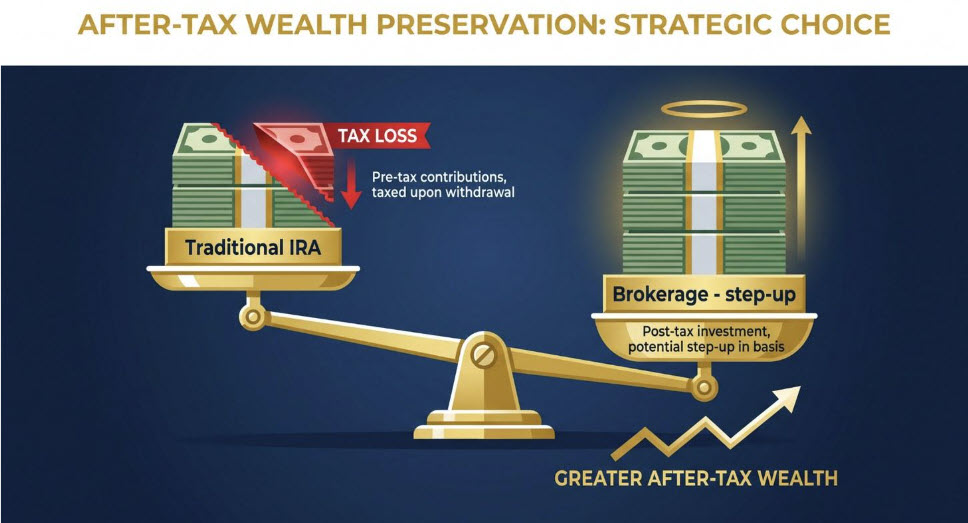
Check 4: Equal is not equal
This check splits families. Same face value, very different after-tax checks.
Say you leave your son a $200,000 traditional IRA and your daughter a $200,000 brokerage account. On paper, fair. In reality, your son owes ordinary income tax on every dollar8 he pulls from that IRA. Your daughter inherits her account with a step-up in basis7 — the built-in gains are wiped clean at death.
The numbers make the gap obvious:
| Heir | Account inherited | Face value | What the tax code does |
|---|---|---|---|
| Son | Traditional IRA | $200,000 | Ordinary income tax on every dollar withdrawn. At a 24% rate, roughly $48,000 goes to the IRS. |
| Daughter | Taxable brokerage | $200,000 | Step-up in basis wipes out the built-in gain at death. She can sell near $200,000 with little or no tax. |
Illustrative only; actual tax depends on each heir’s bracket.
So inventory your accounts by tax type. Pre-tax IRAs and 401(k)s on one side. Roth accounts, taxable brokerage, and cash on the other. Then adjust the designations so heirs land at equal after-tax amounts, not equal sticker prices.
Check 5: Give the taxable accounts away
This one matters only if you give to charity. It saves real money.
A charity pays no income tax on an inherited traditional IRA9. Your kids pay full income tax on the same dollars. So point your most tax-heavy assets at the charity — traditional IRAs, non-qualified annuities, the accounts that hand your heirs a tax bill. Send those to the causes you support, and the income tax on those dollars goes away because the charity is tax-exempt.
Then save the good stuff for family. Roth IRAs and appreciated stock that gets the step-up7. Same total gift, and for an heir in a 24% bracket, every $100,000 of IRA routed to charity instead of to that heir avoids roughly $24,000 of income tax. The gain shrinks if your heirs sit in a low bracket, and it vanishes if you would not have given to charity anyway. Do not give to save tax; give, then give the right account.
Check 6: Trusts, multiple heirs, and the SECURE Act
This is where people trip on the fine print. Three traps.
First, trusts. Name a trust as the beneficiary of an IRA and it has to qualify as a see-through trust10. Get the language wrong and the account is treated as having no designated beneficiary11: forced empty on a five-year clock if you die before your required beginning date — a tax squeeze your heirs feel right away. Confirm the wording with your attorney.
Second, multiple heirs on one IRA. The designated beneficiary is locked in by September 3012 of the year after death, and heirs left sharing a single account can be pushed onto the oldest one’s timeline. The fix is a deadline: split the money into separate inherited IRAs by December 31 of that same year, so each heir uses their own life expectancy. Under the SECURE Act ten-year rule11, most non-spouse heirs still have to empty the account within ten years — but eligible designated beneficiaries13, like a surviving spouse or a disabled heir, are exempt.
Third, annuities. Move ownership of a non-qualified annuity into an irrevocable trust and you can lose the tax deferral you paid for14, with the gains taxed as they accrue under Section 72(u). Naming the trust as beneficiary is a different act from making it the owner. Check that one carefully before you sign.

Run the whole check in one pass
Here is the full sequence. Confirm every name matches your wishes today. Strip ‘my estate’ off the forms and add contingents. Keep minors out of direct designations. Balance heirs by after-tax value. Send tax-heavy accounts to charity. Get the trust and multi-heir rules right.
| # | Confirm this | The fix |
|---|---|---|
| 1 | Every primary and contingent name matches what you want today. | Pull each account. Update stale names. Check joint, TOD, and POD titling too. |
| 2 | No account names ‘my estate’ on any line. | Remove ‘my estate.’ Name real people. Add a contingent to every account. |
| 3 | No minor is named directly. | Route the money through a trust or a UTMA account with an adult custodian. |
| 4 | Heirs are balanced by after-tax value, not sticker price. | Sort accounts by tax type. Adjust shares so heirs land at equal after-tax dollars. |
| 5 | Tax-heavy accounts point to charity if you give. | Send traditional IRAs and annuities to charity. Leave Roth and appreciated stock to family. |
| 6 | Trust and multi-heir language is correct. | Confirm see-through trust wording. Split multi-heir IRAs into separate inherited accounts. |
This walkthrough is educational, not legal or tax advice. Beneficiary rules turn on your state and your exact accounts, so confirm the trust and annuity language with a qualified attorney or tax professional who knows your full situation before you sign.
Notes
- The beneficiary form controls who inherits — Edelman Financial Engines explains why beneficiary designations override the instructions in a will. https://www.edelmanfinancialengines.com/education/estate/beneficiary-designation-vs-will/ ↩
- Designations supersede the will by law — Trust & Will on keeping designations current because they control regardless of the will. https://trustandwill.com/learn/beneficiary-designation-vs-will ↩
- TOD, POD, and joint accounts pass outside probate — ElderLawAnswers on how payable-on-death and transfer-on-death accounts transfer by operation of law and bypass probate. https://www.elderlawanswers.com/passing-on-assets-outside-of-probate-pods-and-tods-15137 ↩
- Naming your estate drops the account into probate — Kiplinger on why naming your estate as IRA beneficiary forces probate, exposes the money to creditors, and can accelerate the payout. https://www.kiplinger.com/retirement/retirement-plans/iras/604980/dont-name-your-estate-as-your-ira-beneficiary ↩
- A minor named directly triggers a court proceeding — LegalClarity, Minor Life Insurance Beneficiary: Rules and Your Options, August 5, 2026: insurers will not pay a minor; a family member must petition a court for authority over the money; funds release at the age of majority. https://legalclarity.org/what-happens-if-a-minor-is-the-beneficiary-on-a-life-insurance-policy/ ↩
- Custodial accounts release the full balance at majority — Chase on custodial accounts transferring the entire balance to the child at the age of majority. https://www.chase.com/personal/investments/learning-and-insights/article/custodial-accounts-when-child-turns-18 ↩
- Step-up in basis wipes out built-in gains at death — Fidelity explains how inherited taxable assets get a cost basis reset to date-of-death value. https://www.fidelity.com/learning-center/personal-finance/what-is-step-up-in-basis ↩
- Inherited traditional IRAs get no step-up — LegalClarity on why inherited IRAs are income in respect of a decedent, get no step-up, and are taxed as ordinary income. https://legalclarity.org/do-inherited-iras-get-a-step-up-in-basis/ ↩
- A charity pays no income tax on an inherited IRA — Fidelity Charitable on how a tax-exempt charity avoids income tax on inherited retirement assets that would tax heirs. https://www.fidelitycharitable.org/guidance/philanthropy/donating-retirement-assets-to-charity.html ↩
- A trust must qualify as a see-through trust — Fidelity Viewpoints, How the SECURE Act impacts IRAs left to a trust, April 3, 2026, on the four see-through requirements. https://www.fidelity.com/viewpoints/wealth-management/insights/iras-left-to-a-trust ↩
- The SECURE Act ten-year rule — IRS Retirement Topics: Beneficiary (reviewed August 1, 2026): most designated beneficiaries must empty the account by the end of the 10th year after death; a non-designated beneficiary follows the pre-2020 rules. https://www.irs.gov/retirement-plans/plan-participant-employee/retirement-topics-beneficiary ↩
- The designated beneficiary is determined by September 30 — IRS Publication 590-B (for 2025 returns) on determining the designated beneficiary, the separate-account deadline, and the shortest-life-expectancy rule for multiple beneficiaries. https://www.irs.gov/pub/irs-pdf/p590b.pdf ↩
- Eligible designated beneficiaries are exempt — Charles Schwab on the eligible-designated-beneficiary categories that are exempt from the ten-year rule. https://www.schwab.com/learn/story/inherited-ira-rules-secure-act-20-changes ↩
- An annuity owned by a non-grantor trust can lose tax deferral — My Annuity Store, Can You Transfer an Annuity to a Trust?, updated March 28, 2026, on IRC Section 72(u). https://myannuitystore.com/retirement-planning/transferring-annuity-to-trust/ ↩
- Joint accounts with right of survivorship pass to the surviving owner outside probate — Nolo, How Joint Owners Can Transfer Survivorship Property After Death, updated October 20, 2025. https://www.nolo.com/legal-encyclopedia/joint-owners-survivorship-32441.html ↩
Important Disclosures
This content is produced by David Berkowitz under ValueAligned Partners, LLC, DBA VAP Wealth Advisors (“VAP Wealth Advisors”), an independent marketing brand, and is provided for general educational and informational purposes only. It is not, and should not be construed as, personalized investment, legal, tax, or accounting advice, nor an offer or solicitation to buy or sell any security.
No advisory relationship. Viewing, reading, or interacting with this content does not create an investment-adviser, attorney-client, or accountant-client relationship. David Berkowitz is an investment adviser representative registered with Savvy Advisors, Inc. (“Savvy”), and all investment advisory services he provides are offered through Savvy. Investment advisory services are offered only through a written agreement with Savvy. ValueAligned Partners, LLC, DBA VAP Wealth Advisors, is an independent marketing brand used for advertising and marketing purposes only; ValueAligned Partners, LLC and Savvy are not related or affiliated. Additional information is available in Savvy Advisors’ Form ADV Part 2A and Form CRS at adviserinfo.sec.gov.
Not legal or estate-planning advice. David Berkowitz is not an attorney, and VAP Wealth Advisors does not practice law, draft legal documents, or provide legal opinions. Any discussion of wills, trusts, powers of attorney, beneficiary designations, or other estate-planning topics is general education only. You should consult a licensed attorney in your state before drafting, signing, or relying on any estate-planning document.
Not tax or accounting advice. David Berkowitz is not a CPA or Enrolled Agent, and VAP Wealth Advisors does not prepare tax returns or provide tax-return preparation services. Any discussion of tax topics is general education intended to help you understand tax-planning concepts and coordinate with your CPA or tax preparer. You should consult a qualified tax professional regarding your specific situation before acting on anything discussed here.
No guarantees; investment risk. All investing involves risk, including possible loss of principal. Past performance is not indicative of, and does not guarantee, future results. Forward-looking statements are opinions as of the date recorded and are subject to change without notice.
Sources and third-party content. Links, tickers, and third-party materials are provided for convenience and do not constitute an endorsement. VAP Wealth Advisors is not responsible for the content of third-party sites.
Positions. David Berkowitz, his clients, employees, and family may own the stocks mentioned in this content. He is under no obligation to update the content or to disclose any future purchases or sales of those stocks.
Important Disclosure: This article is provided for informational and educational purposes only and should not be construed as investment, legal, tax, or accounting advice, or as a recommendation to purchase, sell, or hold any security. The views expressed are based on publicly available information and the author’s analysis as of the publication date and are subject to change without notice. References to specific companies, securities, or market participants are provided solely to illustrate accounting concepts and should not be interpreted as recommendations or endorsements. Different analysts, investors, and accounting professionals may reasonably reach different conclusions based on the same information. Past accounting practices or financial reporting trends are not indicative of future company performance or investment results. Investors should evaluate investment opportunities in light of their own financial circumstances and objectives and consult their own professional advisers before making investment decisions.
Third-Party Information. Certain information, data, and quoted material contained in this article has been obtained from third-party sources, including company press releases and SEC filings, financial data providers (Internal Revenue Service publications, Fidelity, Fidelity Charitable, Charles Schwab, Chase, Edelman Financial Engines), news services (Kiplinger), and financial commentary sources (Trust & Will, ElderLawAnswers, Policygenius, LegalClarity, My Annuity Store). While these sources are believed to be reliable, the author and Savvy Advisors, Inc. have not independently verified the accuracy or completeness of such third-party information and make no representation or warranty, express or implied, as to its accuracy, completeness, or timeliness. Third-party content, including analyst consensus estimates, price targets, and buy/sell ratings cited herein, reflects the views of the respective analysts and organizations, not the views of the author or Savvy Advisors. The author is not affiliated with any of the cited third-party sources. Readers should conduct their own independent research and due diligence before making investment decisions.
The Firm, employees, or advisory clients may hold positions in securities discussed in this article. Such holdings may change at any time without notice and should not be construed as a recommendation to buy or sell any security. Any references to publicly traded companies within this article are provided solely for informational and illustrative purposes, based on their relevance to the subject matter discussed. Such references should not be construed as a recommendation, endorsement, or solicitation to buy or sell any securities. The inclusion of any company does not reflect any opinion regarding its investment merits, and readers should not rely on this content as investment advice.
This content was created with the assistance of third-party artificial intelligence and was reviewed and approved by David Berkowitz prior to publication.
All advisory services are offered through Savvy Advisors, Inc. (“Savvy Advisors”), an investment advisor registered with the Securities and Exchange Commission (“SEC”). Savvy Wealth Inc. (“Savvy Wealth”) is a technology company and the parent company of Savvy Advisors. Savvy Wealth and Savvy Advisors are often collectively referred to as “Savvy”.
David L Berkowitz is an investment advisor representative registered with Savvy Advisors, Inc. (“Savvy”). All investment advisory services offered by David L Berkowitz are offered through Savvy. ValueAligned Partners, LLC (also doing business as VAP Wealth Advisors) is an independent marketing brand name used by David L Berkowitz for advertising and marketing purposes only. ValueAligned Partners, LLC and Savvy are not related or affiliated. For more information about Savvy, please visit our website at savvywealth.com/advisor.