
The 10-year Treasury closed at 5.28% and the S&P 500 fund slipped 0.2%. Earnings are carrying more of the load, and that changes what an owner should check.
By David Berkowitz · Berk on Value · October 5, 2026
1. Borrowing got more expensive. Stocks barely moved.
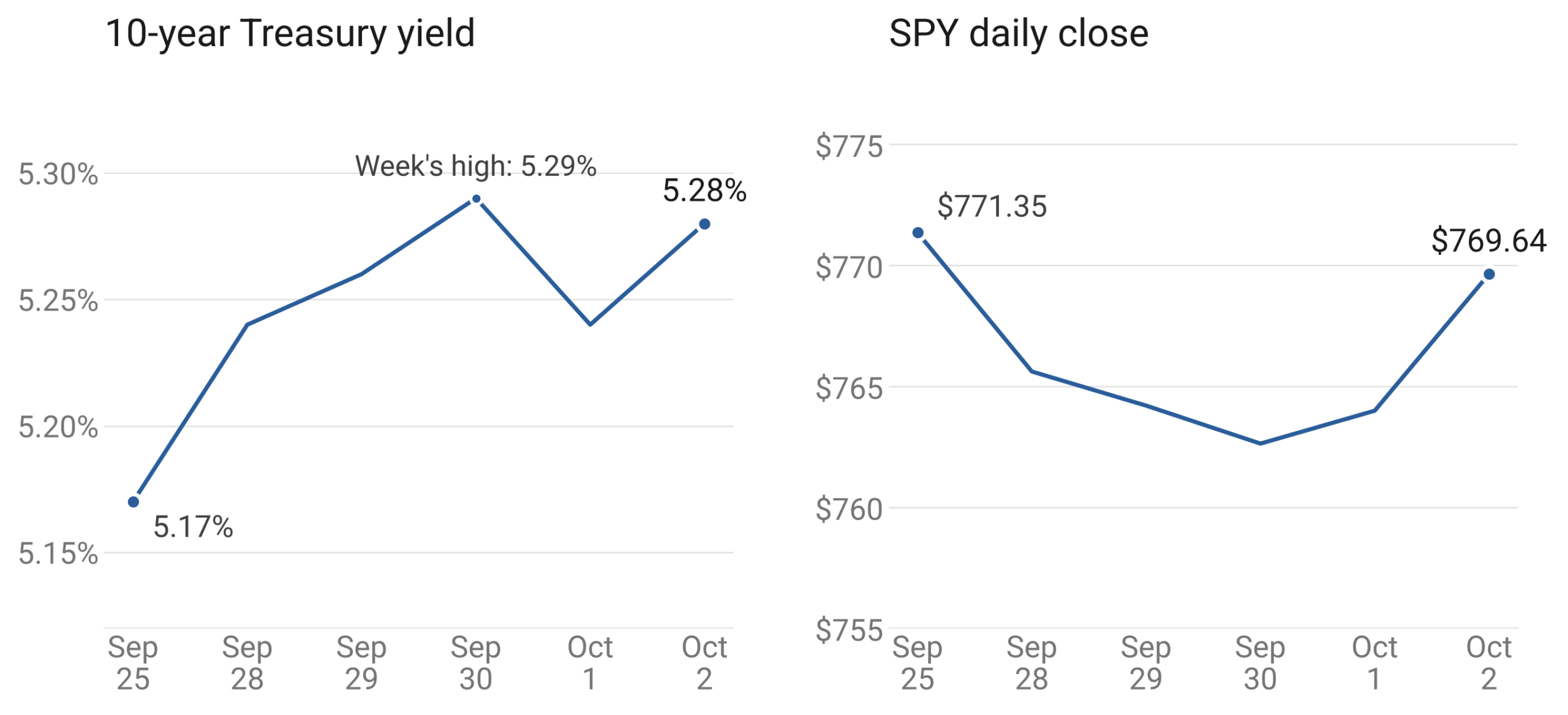
Interest rates and stocks parted ways last week. The 10-year Treasury yield closed Friday, October 2, at 5.28%.1 A week earlier it stood at 5.17%. It closed at 5.29% on Wednesday, the week’s high.
SPY, the fund that tracks the S&P 500, ended the week down 0.2%.2
Rising yields press on stock prices in two ways. They raise what companies pay to borrow. They also raise what you can earn in a Treasury without owning any business risk. Both tend to shrink what investors are willing to pay for a dollar of profit.
Yardeni Research titled its October 3 note “Stocks Ignoring Bonds, For Now.”3 The numbers in that note point to earnings.
2. Earnings are doing more of the work
Yardeni puts S&P 500 forward earnings at a record $406.45 a share.3 Forward earnings are what analysts expect companies to earn over the next 12 months. The index trades at 19.0 times that number.
By Yardeni’s count, forward earnings are up 28.2% this year. The forward price-to-earnings multiple is down 12.8%. The index still rose, because rising earnings more than offset the shrinking multiple.
That cushion has limits. With the 10-year above 5%, Yardeni sees more downside than upside for valuation multiples through year-end. The firm kept its S&P 500 targets for year-end 2026 and mid-2027 unchanged. Those targets are Yardeni’s forecasts. They carry no guarantee, and I set no index target of my own.
Forward-looking statements are opinions as of the recording date and are subject to change without notice.
When the multiple shrinks, earnings have to do the lifting. A business with flat profits has far less protection.
That is where an owner’s attention belongs this earnings season. Look for revenue that turns into cash. Look for customers who keep placing orders. Look for costs that stay in check. A good story persuades less when money costs more. The reported numbers have to carry it.
3. A weak jobs report did not settle the rate debate
Nonfarm payrolls rose 29,000 in September. Revisions cut July and August by a combined 60,000.4 Forecasts had called for 80,000 to 100,000.3
The 10-year yield dipped on the news, then recovered.3 It closed Friday at 5.28%, up from 5.24% on Thursday.1
A soft jobs number tends to lower expectations for more tightening. Long-term yields can stay high anyway when investors want extra pay for fiscal risk. One report does not decide which force wins.
The two-year Treasury yield ended the week at 4.83%,1 well above the Federal Reserve’s target range of 3.75% to 4.00%.5 Yardeni reads the two-year’s premium over the federal funds rate as the market pricing in more rate increases.3 That is a market reading. The Fed’s next scheduled decision comes at its October 27 to 28 meeting.6
For an owner, two things matter more than the Fed’s next move. One is how long expensive money lasts. The other is when each company’s debt comes due.
4. Bond buyers are charging for weak finances
Yardeni attributes most of this year’s rise in Treasury yields to higher real yields, with inflation expectations little changed.3 A real yield is the return after expected inflation. When it rises, lenders want more pay before inflation even enters the math.
France shows how that premium works. The spread between French and German 10-year yields jumped on October 1.7 That was the day France presented a 2027 budget that aims to hold the deficit to 5.0% of GDP.8 Inflation runs hot in both countries, so Yardeni reads the gap as a fiscal-risk premium.7
The same sorting applies to companies. Weaker borrowers pay more. In my view, a business with a strong balance sheet gains relative appeal as the general level of rates rises.
Credit is the place to watch for trouble. Yardeni points to wider credit-default-swap spreads and another quarter of heavy redemption requests at nontraded private-credit funds. It says that stress has not spilled into the broad stock market.3 A borrower facing a higher Treasury rate and a wider risk premium at the same time has a harder time refinancing.
5. What moved under the surface
The flat week for the broad market hid a split.
| Fund | What it tracks | Week | Year to date |
|---|---|---|---|
| SPY | S&P 500, weighted by company size | -0.2% | +12.9% |
| RSP | S&P 500, equal weights | -0.7% | +9.5% |
| QQQ | Nasdaq-100 | +0.7% | +22.0% |
| IWM | Russell 2000 small companies | -0.2% | +14.4% |
Price change from Sept. 25 to Oct. 2, 2026, and from Dec. 31, 2025 to Oct. 2, 2026, based on daily closing prices from Financial Modeling Prep. Dividends excluded.2 These figures are based on historical market data over the periods studied and are provided for educational purposes only. Past performance does not guarantee future results.
QQQ, the Nasdaq-100 fund, led. The equal-weight S&P 500 fund fell 0.7%, more than the 0.2% for the standard one. That pattern fits gains concentrated in a small group of large companies.
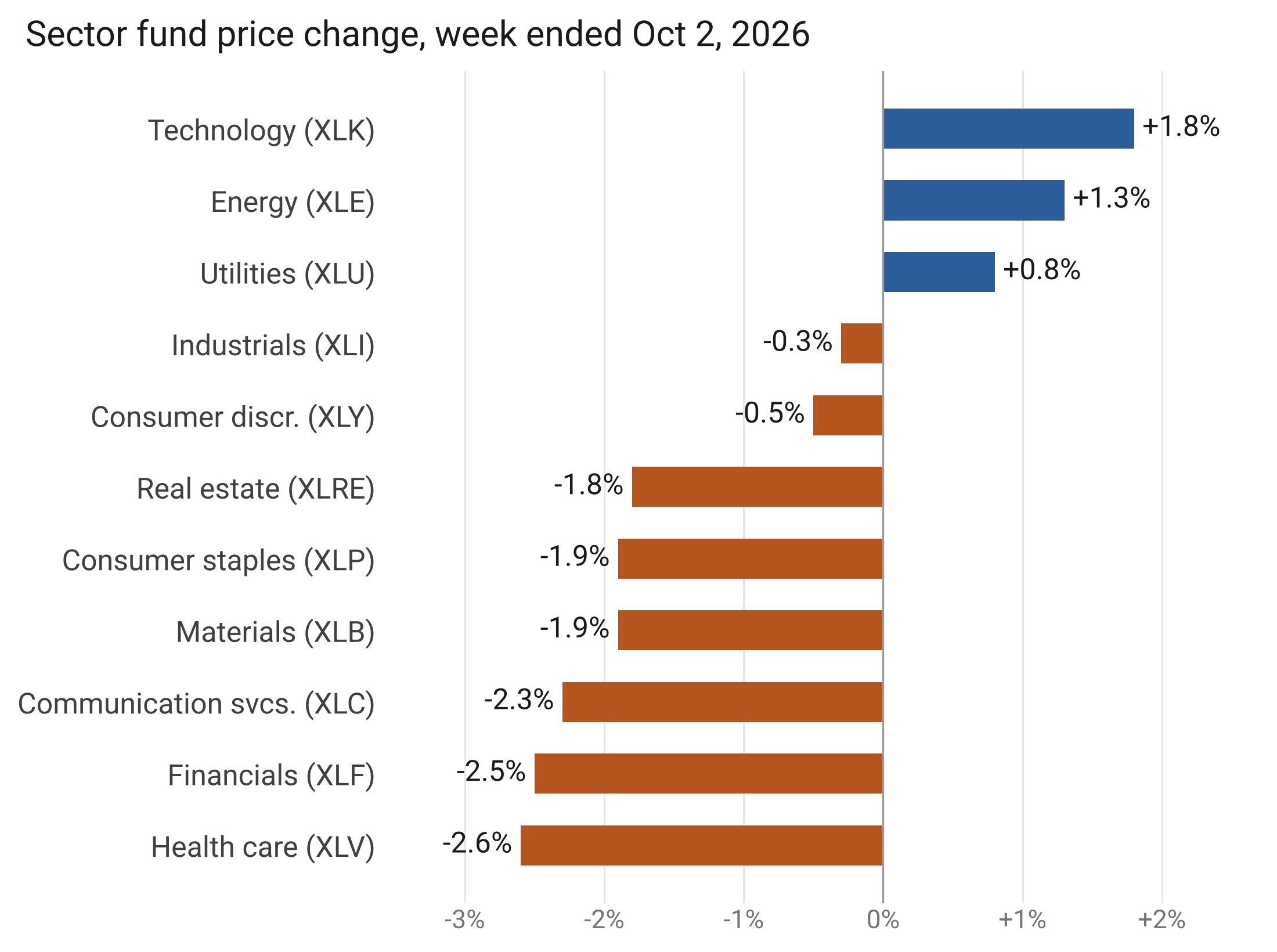
Technology led at +1.8%, then energy at +1.3% and utilities at +0.8%. Health care was weakest at -2.6%, with financials at -2.5% and communication services at -2.3%.
Rates do not explain the whole pattern. Utilities borrow heavily and pay large dividends, which usually makes them sensitive to rising rates. They gained anyway.
Inside the industries, the VanEck Semiconductor fund (SMH) gained 4.0%. Energy split in two. Oil and gas producers (XOP) rose 1.9% while oil-service companies (OIH) fell 2.8%.
6. The S&P 500’s biggest winners and losers
I screened every S&P 500 security with a closing price on both September 25 and October 2. That covers 503 of the index’s 504 listings. Vylor joined the index on October 1 and had no September 25 price.9 Prices come from Yahoo Finance, spot-checked against two other providers.10
| Company | Week | What the record shows |
|---|---|---|
| Five strongest | ||
| Carnival (CCL) | +15.8% | Record 2027 booked occupancy and pricing; raised full-year outlook, Sept. 29 |
| Lumentum (LITE) | +15.3% | Bernstein began coverage with an Outperform rating, Oct. 1 |
| Synopsys (SNPS) | +15.1% | Fiscal 2027 revenue guidance above estimates; OpenAI and AWS deals, Sept. 30 |
| Royal Caribbean (RCL) | +14.4% | No company catalyst found; a lift from Carnival's bookings is plausible, not confirmed |
| Coherent (COHR) | +13.9% | Bernstein began coverage with an Outperform rating, Oct. 1 |
| Five weakest | ||
| Fair Isaac (FICO) | -23.4% | Mortgage-pricing change puts VantageScore alongside FICO, Sept. 28 |
| AppLovin (APP) | -13.7% | Legal fight with Unity over bidding data; no single cause confirmed |
| Global Payments (GPN) | -9.4% | No company announcement found during the week |
| Western Digital (WDC) | -9.1% | Report that rival Toshiba plans to double hard-drive output |
| International Paper (IP) | -8.7% | No major operating announcement found during the week |
Weekly price change from Sept. 25 to Oct. 2, 2026. Dividends excluded. Corteva is ranked on a spin-off-comparable basis, explained below.
Most of the winners had news. Carnival raised its full-year outlook despite a spike in fuel prices.11 Fuel and debt remain the tests for a cruise line. Synopsys guided fiscal 2027 revenue to $11.10 billion to $11.20 billion, above the $10.81 billion analysts expected.12 Its new deals still have to turn into earned revenue.
Lumentum and Coherent rose after Bernstein began covering them with Outperform ratings.13 A rating moves a price. Operating results still have to back it up. Royal Caribbean’s own releases that week covered new itineraries and entertainment, and none explains the gain.14
Fair Isaac is the one I would study hardest. On the evening of September 28, the director of the Federal Housing Finance Agency announced a single mortgage-pricing grid that puts VantageScore alongside the FICO Classic score. Rocket Mortgage announced plans to use VantageScore.15 Fannie Mae and Freddie Mac published the aligned fees on September 30.16
In my view, that goes straight to Fair Isaac’s competitive position and pricing power in mortgages. A change like that calls for fresh work on the business, and a decline that simply tracks the market calls for much less. Telling the two apart is most of the job.
The other declines had thinner records. AppLovin is in a legal fight with Unity over the collection of bidding data.17 Western Digital fell on a report that rival Toshiba plans to double hard-disk-drive production.18 Global Payments and International Paper had no company announcement that explains the move.
7. The ValueAligned Portfolio: five up, five down
Below are the five strongest and five weakest ValueAligned Portfolio holdings for the week, ranked by price change. Clients I advise through Savvy hold these ten stocks.
These are individual stock returns, not the return of any portfolio or model; nobody holds all of these in these weights; no account result is being shown.
| Company | Week | What the record shows |
|---|---|---|
| Five strongest | ||
| Accenture (ACN) | +12.9% | Fiscal fourth-quarter revenue of $18.68 billion beat its own guided range, Oct. 1 |
| TSMC ADR (TSM) | +4.9% | Report of an early-stage Texas fab campus plan; no comment from TSMC |
| NVIDIA (NVDA) | +3.9% | Closed at a record high on Oct. 2, its first since May |
| Amazon (AMZN) | +0.7% | Multi-year custom-silicon agreement with Synopsys, Sept. 30 |
| Broadcom (AVGO) | +0.7% | Report of about $60 billion in debt financing for AI chips |
| Five weakest | ||
| KKR (KKR) | -6.6% | Routine company news; private-credit stress as sector context |
| LVMH ADR (LVMUY) | -6.4% | No earnings warning; third-quarter revenue due Oct. 12 |
| General Motors (GM) | -5.3% | Third-quarter U.S. sales of 670,974 vehicles, down 6% |
| S&P Global (SPGI) | -4.2% | Routine announcements; no operating warning |
| Novo Nordisk ADR (NVO) | -3.8% | FDA extended its review of the hemophilia drug denecimig |
Weekly price change from Sept. 25 to Oct. 2, 2026, based on daily closing prices from Financial Modeling Prep. Dividends excluded.2
Accenture is the clearest case. On October 1 it reported fiscal fourth-quarter revenue of $18.68 billion, above its own guided range of $17.75 billion to $18.40 billion.20 The shares posted their largest one-day gain on record that day.21 The question for an owner is whether the new work turns into profitable growth and cash.
Bloomberg reported that TSMC is considering a Texas manufacturing campus of several fabs. People familiar with the plans said they are at an early stage, and TSMC said it had no comment on market rumors.22 NVIDIA closed at a record high on October 2, its first since May.23 Synopsys and Amazon announced a multi-year custom-silicon agreement on September 30.24 For all three, the case still rests on customer demand and the returns on what they spend.
Broadcom carries a different question. Bloomberg reported that it is assembling about $60 billion of debt financing to fund chips and infrastructure for Anthropic and other companies. Neither company had announced the deal.25 With rates this high, demand that leans on borrowed money needs a check on how durable that funding is.
On the downside, Novo Nordisk said on October 2 that the FDA had extended its review of denecimig, a hemophilia treatment, because of remediation work at a manufacturing facility. The company said the FDA had identified no deficiencies in the clinical efficacy or safety data, and that its 2026 financial outlook is unchanged.26 The evidence does not show the delay explains the whole decline.
GM reported third-quarter U.S. sales of 670,974 vehicles, down 6%, and cited a much smaller EV market and discontinued vehicles.27 KKR, LVMH and S&P Global posted routine news and no operating warning.28,29,30 A one-week drop says little about a business on its own.
8. What I am watching this week
Forward-looking statements are opinions as of the recording date and are subject to change without notice.
In the constructive case, earnings expectations hold, yields stabilize and credit stays orderly. Strong businesses can then support their stock prices without a return to richer multiples. A narrowing gap between the equal-weight and standard S&P 500 funds would show more stocks taking part.
In the adverse case, borrowing costs rise further while demand softens or credit spreads widen. That squeezes both expected earnings and the multiple investors pay for them. Banks, homebuilders and companies that depend on outside funding are the groups to watch.
The signals I am tracking are Treasury yields, credit spreads, company guidance and the debt maturities of the businesses I follow.
9. For long-term owners
Rates are the central risk right now. Real borrowing costs have risen this year, and bond buyers are charging extra where finances are weak. That leaves earnings to do more of the work while valuation multiples are under pressure.
Broad averages hide what happens underneath. The same backdrop lifted Accenture and sank Fair Isaac this week, for reasons specific to each company.
A price move raises the question. Company evidence answers it.
That is the discipline I try to apply to every holding. Higher rates make it harder to skip.
How the numbers were measured
Weekly change equals the October 2 close divided by the September 25 close, minus one. Year to date uses the December 31, 2025 close. Fund and holding figures use daily closing prices from Financial Modeling Prep, adjusted for splits only, with no dividends added. The S&P 500 screen used Yahoo Finance closes, spot-checked against Financial Modeling Prep and Fiscal.ai. Percentages are rounded to one decimal after calculation.
More writing like this is at the Berk on Value blog.
Get the next one in your inbox.
Plain-English lessons on owning great businesses, sent free.
Notes
- U.S. Department of the Treasury, Daily Treasury Par Yield Curve Rates, September and October 2026. 10-year: 5.17% on Sept. 25, 5.29% on Sept. 30, 5.24% on Oct. 1, 5.28% on Oct. 2. 2-year: 4.83% on Oct. 2. https://home.treasury.gov/resource-center/data-chart-center/interest-rates/TextView?type=daily_treasury_yield_curve&field_tdr_date_value_month=202610https://home.treasury.gov/resource-center/data-chart-center/interest-rates/TextView?type=daily_treasury_yield_curve&field_tdr_date_value_month=202609↩
- Financial Modeling Prep, daily closing prices for Dec. 31, 2025 and Sept. 25 through Oct. 2, 2026. Adjusted for stock splits only; no dividends added. Used for every fund and holding figure, including the three ADRs. https://financialmodelingprep.com/↩
- Yardeni Research (Ed Yardeni and Toby Hearst), “US MARKET CALL: Stocks Ignoring Bonds, For Now,” Oct. 3, 2026. Forward earnings of $406.45, forward P/E of 19.0, forward earnings up 28.2% and forward P/E down 12.8% year to date, payroll forecasts, the 2-year yield reading, credit and private-credit stress. https://www.yardeniquicktakes.com/us-market-call-stocks-ignoring-bonds-for-now/↩
- U.S. Bureau of Labor Statistics, Employment Situation Summary for September 2026, Oct. 2, 2026. Payrolls up 29,000; July and August revised down a combined 60,000. https://www.bls.gov/news.release/empsit.nr0.htm↩
- Board of Governors of the Federal Reserve System, “Federal Reserve issues FOMC statement,” Sept. 16, 2026. Target range for the federal funds rate set at 3.75% to 4.00%. https://www.federalreserve.gov/newsevents/pressreleases/monetary20260916a.htm↩
- Board of Governors of the Federal Reserve System, Meeting calendars, statements, and minutes. Next scheduled meeting Oct. 27 to 28, 2026. https://www.federalreserve.gov/monetarypolicy/fomccalendars.htm↩
- Yardeni Research (Ed Yardeni and Toby Hearst), “GLOBAL MARKET CALL: Bond Vigilantes Gone Wild,” Oct. 4, 2026. https://www.yardeniquicktakes.com/global-market-call-bond-vigilantes-gone-wild/↩
- French Ministry of the Economy, “Présentation du projet de budget pour 2027,” Oct. 1, 2026. 2027 deficit target of 5% of GDP. https://www.economie.gouv.fr/actualites/video-presentation-du-projet-de-loi-de-finances-pour-2027↩
- S&P Dow Jones Indices, “Vylor Added to the S&P 500; Twilio Set to Join S&P 500; Others to Join S&P MidCap 400 and S&P SmallCap 600,” Oct. 1, 2026. https://press.spglobal.com/2026-10-01-Vylor-Added-to-the-S-P-500-Twilio-Set-to-Join-S-P-500-Others-to-Join-S-P-MidCap-400-and-S-P-SmallCap-600↩
- Yahoo Finance daily closing prices for every S&P 500 security on Sept. 25 and Oct. 2, 2026, spot-checked against Financial Modeling Prep (25 tickers, including all ten ranked here) and Fiscal.ai (42 tickers) on the same price-only basis. https://finance.yahoo.com/↩
- Carnival Corporation & plc, third-quarter 2026 results, Form 8-K exhibit, Sept. 29, 2026. https://www.sec.gov/Archives/edgar/data/815097/000081509726000104/a20263qearningsrelease8-k.htm↩
- Reuters, “Synopsys shares jump on robust growth outlook, OpenAI and AWS deals,” Oct. 1, 2026. https://www.reuters.com/business/synopsys-shares-jump-robust-growth-outlook-openai-aws-deals-2026-10-01/↩
- Yahoo Finance, “Coherent, Lumentum, and Ciena stocks surge on bullish Wall Street call,” Oct. 1, 2026. Bernstein initiated coverage with Outperform ratings. https://finance.yahoo.com/markets/stocks/article/coherent-lumentum-and-ciena-stocks-surge-on-bullish-wall-street-call-182906439.html↩
- Royal Caribbean Group, press releases dated Sept. 30 and Oct. 2, 2026 (itinerary and entertainment announcements). https://www.rclinvestor.com/press-releases/↩
- Yahoo Finance, “Fair Isaac stock plunges 20% after Fannie and Freddie open door to FICO credit score rival,” Sept. 29, 2026; Forbes, Sept. 29, 2026, and TheStreet, on the timing of the Sept. 28 announcement and Rocket Mortgage’s plans. https://finance.yahoo.com/markets/stocks/article/fair-isaac-stock-plunges-20-after-fannie-and-freddie-open-door-to-fico-credit-score-rival-142841650.htmlhttps://www.forbes.com/sites/fionariley/2026/09/29/fico-stock-crashes-27-after-trumps-housing-chief-roils-credit-reporting-industry/https://www.thestreet.com/real-estate/mortgage-rule-change-vantage-score-fico-stock-falls↩
- Federal Housing Finance Agency, Credit Scores. Aligned upfront fees across Classic FICO and VantageScore 4.0, published Sept. 30, 2026. https://www.fhfa.gov/policy/credit-scores↩
- Digiday, “Mobile ad giants AppLovin and Unity locked in legal dispute over data collection,” Sept. 29, 2026. https://digiday.com/marketing/mobile-ad-giants-applovin-and-unity-locked-in-legal-dispute-over-data-collection/↩
- Yahoo Finance, “Seagate, Western Digital stocks sink as rival Toshiba’s expansion plans hit storage highfliers,” Oct. 2, 2026. https://finance.yahoo.com/markets/article/seagate-western-digital-stocks-sink-as-rival-toshibas-expansion-plans-hit-storage-highfliers-142919224.html↩
- Corteva, Inc., “Corteva Board of Directors Approves Vylor Distribution,” Sept. 14, 2026 (one Vylor share for each Corteva share held at the Sept. 24 record date), and Vylor’s Form 8-K of Oct. 1, 2026 confirming the completed distribution. https://www.corteva.com/news/corteva-board-approves-vylor-distribution.htmlhttps://www.sec.gov/Archives/edgar/data/2128626/000119312526409909/d115079d8k.htm↩
- Accenture plc, “Accenture Reports Fourth-Quarter and Full-Year Fiscal 2026 Results,” Form 8-K exhibit, Oct. 1, 2026. https://www.sec.gov/Archives/edgar/data/1467373/000146737326000037/q4fy26earnings8-kexhibit.htm↩
- Quartz, “Accenture posts record one-day gain, up 22%, after Q4 beat,” Oct. 1, 2026. https://qz.com/accenture-stock-earnings-beat-record-gain-100126↩
- Insurance Journal (Bloomberg), “TSMC Mulls Multibillion-Dollar Texas Site for More AI Chips,” Oct. 2, 2026. https://www.insurancejournal.com/news/southcentral/2026/10/02/887682.htm↩
- Quartz, “Nvidia hits record close, nears unprecedented $6 trillion valuation,” Oct. 2, 2026. https://qz.com/nvidia-stock-record-high-market-cap-6-trillion-100226↩
- Synopsys, Inc., “Synopsys and Amazon Announce Strategic, Multi-year IP Agreement for Custom Silicon,” Sept. 30, 2026. https://investor.synopsys.com/news/news-details/2026/Synopsys-and-Amazon-Announce-Strategic-Multi-year-IP-Agreement-for-Custom-Silicon-Collaboration-Also-Extends-to-Cloud-and-AI-Powered-Engineering/default.aspx↩
- Quartz, “Broadcom is starting to raise $60 billion in debt to finance AI chips for Anthropic,” Oct. 2, 2026, and American Bazaar, Oct. 2, 2026, both reporting on Bloomberg’s account of the same date (Bloomberg is paywalled). https://qz.com/broadcom-60-billion-debt-financing-anthropic-ai-chips-100226https://americanbazaaronline.com/2026/10/02/broadcom-lines-up-60b-financing-package-to-fund-ai-chips-489265/https://www.bloomberg.com/news/articles/2026-10-02/broadcom-starts-amassing-60-billion-to-fund-chips-for-anthropic↩
- Novo Nordisk A/S, “Novo provides update on the denecimig Biologics License Application (BLA) in the US,” company announcement, Oct. 2, 2026. https://www.novonordisk.com/news-and-media/news-and-ir-materials/news-details.html?id=917287↩
- General Motors, “GM’s Winning Portfolio Continues Getting Stronger,” Oct. 1, 2026. Third-quarter U.S. sales of 670,974 vehicles, down 6%. https://investor.gm.com/news-releases/news-release-details/gms-winning-portfolio-continues-getting-stronger↩
- KKR & Co. Inc. via Business Wire, “KKR & Co. Inc. to Announce Third Quarter 2026 Results,” Sept. 29, 2026. https://www.businesswire.com/news/home/20260929150919/en/KKR-Co.-Inc.-to-Announce-Third-Quarter-2026-Results↩
- LVMH newsroom, items dated Sept. 28 to Oct. 2, 2026, and LVMH financial calendar (third-quarter revenue Oct. 12, 2026). https://www.lvmh.com/en/news-lvmh↩
- S&P Global, “S&P Global brings Credit Ratings to the S&P Global AI Data Portal,” Sept. 28, 2026. https://press.spglobal.com/2026-09-28-S-P-Global-brings-Credit-Ratings-to-the-S-P-Global-AI-Data-Portal↩
Important Disclosures
This content is produced by David Berkowitz under ValueAligned Partners, LLC, DBA VAP Wealth Advisors (“VAP Wealth Advisors”), an independent marketing brand, and is provided for general educational and informational purposes only. It is not, and should not be construed as, personalized investment, legal, tax, or accounting advice, nor an offer or solicitation to buy or sell any security.
No advisory relationship. Viewing, reading, or interacting with this content does not create an investment-adviser, attorney-client, or accountant-client relationship. Investment advisory services are offered only through a written agreement with Savvy. Additional information is available in Savvy Advisors’ Form ADV Part 2A and Form CRS at adviserinfo.sec.gov.
Not legal or estate-planning advice. David Berkowitz is not an attorney, and VAP Wealth Advisors does not practice law, draft legal documents, or provide legal opinions. Any discussion of wills, trusts, powers of attorney, beneficiary designations, or other estate-planning topics is general education only. You should consult a licensed attorney in your state before drafting, signing, or relying on any estate-planning document.
Not tax or accounting advice. David Berkowitz is not a CPA or Enrolled Agent, and VAP Wealth Advisors does not prepare tax returns or provide tax-return preparation services. Any discussion of tax topics is general education intended to help you understand tax-planning concepts and coordinate with your CPA or tax preparer. You should consult a qualified tax professional regarding your specific situation before acting on anything discussed here.
No guarantees; investment risk. All investing involves risk, including possible loss of principal. Past performance is not indicative of, and does not guarantee, future results. Forward-looking statements are opinions as of the date recorded and are subject to change without notice.
Sources and third-party content. Links, tickers, and third-party materials are provided for convenience and do not constitute an endorsement. VAP Wealth Advisors is not responsible for the content of third-party sites.
Positions. David Berkowitz, his clients, employees, and family may own the stocks mentioned in this content. He is under no obligation to update the content or to disclose any future purchases or sales of those stocks.
All advisory services are offered through Savvy Advisors, Inc. (“Savvy Advisors”), an investment advisor registered with the Securities and Exchange Commission (“SEC”). Savvy Wealth Inc. (“Savvy Wealth”) is a technology company and the parent company of Savvy Advisors. Savvy Wealth and Savvy Advisors are often collectively referred to as “Savvy”.
David L Berkowitz is an investment advisor representative registered with Savvy Advisors, Inc. (“Savvy”). All investment advisory services offered by David L Berkowitz are offered through Savvy. ValueAligned Partners, LLC (also doing business as VAP Wealth Advisors) is an independent marketing brand name used by David L Berkowitz for advertising and marketing purposes only. ValueAligned Partners, LLC and Savvy are not related or affiliated. For more information about Savvy, please visit our website.
These figures are based on historical market data over the periods studied and are provided for educational purposes only. Past performance does not guarantee future results.
Past Performance. This article discusses the historical performance of each exchange-traded fund and company named in this article (the tickers listed in its tables and sector chart or named in its text, plus Corteva, Inc. (CTVA) and Vylor (VYLR)) as a publicly traded security over various time periods, including weekly and year-to-date price changes and prior closing price levels. Past performance of any security is not indicative of future results. Historical returns, including any compounded annual growth rates, dividend histories, or prior valuation levels cited herein, do not guarantee or predict future performance. Actual future results may differ materially from historical performance due to market conditions, economic factors, company-specific risks, and other variables. Investors should not assume that past trends will continue. Any investment involves the risk of loss, including the potential loss of principal invested.
Forward-Looking Statements. This article contains forward-looking statements, including but not limited to: Yardeni Research’s unchanged S&P 500 targets for year-end 2026 and mid-2027 and its view that valuation multiples face more downside than upside through year-end; market pricing of further Federal Reserve rate increases; Carnival’s full-year outlook and 2027 booking levels; Synopsys’s fiscal 2027 revenue guidance; Bernstein’s Outperform ratings on Lumentum and Coherent; Novo Nordisk’s 2026 financial outlook and the extended FDA review of denecimig; reported plans for a TSMC manufacturing campus in Texas and for Broadcom’s debt financing; the constructive and adverse cases described for the week of October 5 to 9; and the author’s own views that earnings now carry more of the load, that companies funding themselves from their own cash have more room to act, that financially strong businesses gain relative appeal as rates rise, and that the mortgage-scoring change calls for fresh work on Fair Isaac’s business. Forward-looking statements are subject to significant risks, uncertainties, and assumptions. Due to various factors, including changes in market conditions, macroeconomic developments, competitive dynamics, regulatory actions, and company-specific execution risks, actual events, results, or the performance of the securities and markets discussed may differ materially from those reflected or contemplated in such forward-looking statements. The author undertakes no obligation to update any forward-looking statement to reflect events or circumstances after the date of this publication. Readers should not place undue reliance on forward-looking statements as a basis for investment decisions.
Third-Party Information. Certain information, data, and quoted material contained in this article has been obtained from third-party sources, including company press releases and SEC filings, financial data providers (Financial Modeling Prep, Yahoo Finance, Fiscal.ai, S&P Dow Jones Indices, the U.S. Department of the Treasury, the U.S. Bureau of Labor Statistics, the Federal Reserve, the Federal Housing Finance Agency, and the French Ministry of the Economy), news services (Reuters, Bloomberg, Yahoo Finance, Quartz, Forbes, TheStreet, American Bazaar, Insurance Journal, Digiday, and Business Wire), and financial commentary sources (Yardeni Research). While these sources are believed to be reliable, the author and Savvy Advisors, Inc. have not independently verified the accuracy or completeness of such third-party information and make no representation or warranty, express or implied, as to its accuracy, completeness, or timeliness. Third-party content, including analyst consensus estimates, price targets, and buy/sell ratings cited herein, reflects the views of the respective analysts and organizations, not the views of the author or Savvy Advisors. The author is not affiliated with any of the cited third-party sources. Readers should conduct their own independent research and due diligence before making investment decisions.
References to specific securities are for illustration and education only and are not a recommendation to buy, sell, or hold any security. David Berkowitz, his clients, and family may hold positions in securities discussed, and those positions may change at any time without notice. Individual holdings depend on each client’s objectives, risk tolerance, tax situation, and time horizon. Consult your own adviser regarding suitability for you. David Berkowitz, his clients, employees, and family may own the stocks mentioned in this content. He is under no obligation to update the content or to disclose any future purchases or sales of those stocks.
This content was created with the assistance of third-party artificial intelligence and was reviewed and approved by David Berkowitz prior to publication.