
For the week ending November 7, 2025, the U.S. stock market experienced a significant pullback , with the S&P 500 falling -1.63% and the Nasdaq 100 dropping 4.04%. Investor concerns over elevated AI valuations drove this decline, a historically extended federal government shutdown, and a softening labor market ( stl.news) ( ABC News) (Weekly PDF).
Key takeaways from this week’s activity:
- Mega-Cap Weakness: The weakness was highly concentrated in mega-cap technology stocks. The S&P 500 Equal Weight Index (RSP) was nearly flat, declining only 0.20% ( Stock Analysis), indicating the average U.S. stock held up significantly better than the market-cap-weighted index (Weekly PDF).
- Defensive Rotation: Investors fled from growth to defensive sectors. Energy (XLE) was the top performer , up 1.60%, followed by Health Care (XLV), up 1.31%. The Technology (XLK) sector was the worst performer, plunging 4.16% (Sector PDF).
- VAP Outperformance: The ValueAligned Portfolio (VAP) successfully navigated the volatility, declining only 1.48% (net of fees) (VAP Weekly PDF) and outperforming the S&P 500 by 0.26% for the week. This was driven by strategic overweights to top-performing sectors, including key holdings Eli Lilly (+7.13% weekly) and Permian Resources (+5.57% weekly) (VAP Annual PDF).
David L. Berkowitz, Chief Investment Officer and Financial Advisor
Started in the early 1990s as a trader and research associate at a $250 million hedge fund, later managing portfolios for 20 years while teaching thousands of employees and executives EVA and value-based management. Today, he helps individuals and families apply those same principles — owning great businesses directly and investing with discipline for life.
How did the U.S. stock market perform this week?
The week ending November 7, 2025, marked a significant pullback across all three major indices as investors grappled with mounting concerns about elevated valuations in artificial intelligence, a prolonged federal government shutdown, and persistent softening in the labor market ( stl.news) ( ABC News) (Weekly PDF).
A critical divergence emerged: the equal-weighted S&P 500 (RSP) declined by only 0.20%, significantly outperforming the market-cap-weighted S&P 500, which fell by 1.63%. This 203 basis point performance gap underscores that the week’s weakness was highly concentrated among mega-cap technology leaders, not a broad-based market deterioration. The resilience of the average stock signals healthy participation among mid-cap and smaller S&P 500 constituents (Weekly PDF) ( Stock Analysis).
Major Index Performance (Week Ending November 7, 2025)
| Index | Symbol | Friday Close | Weekly Change | YTD % |
|---|---|---|---|---|
| S&P 500 | SPY | $6,728.81 | -1.63% | +15.63% |
| S&P 500 Equal Weight | RSP | $187.56 | -0.20% | +8.46% |
| Russell 2000 | ^RUT | 2,432.82 | -1.94% | +10.50% |
| Nasdaq 100 | ^NDX | 25,059.81 | -4.04% | +21.70% |
The S&P 500 tracks the 500 largest publicly traded companies by market capitalization. The Invesco S&P 500 Equal Weight ETF (RSP) provides a more balanced view by eliminating mega-cap concentration bias. The Russell 2000 encompasses small-cap companies, while the Nasdaq 100 is heavily weighted toward technology and growth stocks ( ABC News) (Weekly PDF) ( Stock Analysis) ( Economic Times) ( stl.news).
Which market sectors won and lost this week?
This week’s performance revealed a pronounced defensive rotation as investors sought refuge from technology volatility and concerns about the government shutdown.
Energy (XLE) led all sectors with a 1.60% gain, benefiting from geopolitical supply concerns and optimism over the China trade deal. Health Care (XLV) advanced 1.31%, driven by strong pharmaceutical earnings (Sector PDF). Defensive positioning dominated, with Real Estate (+0.90%), Financials (+0.78%), Utilities (+0.66%), and Consumer Staples (+0.56%) all posting gains.
Growth sectors experienced significant pressure. Technology (XLK) was the worst-performing sector , plunging 4.16%. Communication Services (XLC) fell 2.35%, and Consumer Discretionary (XLY) dropped 1.70% (Sector PDF).
- Concrete Takeaway: The market clearly favored defensive, value-oriented sectors over high-growth technology.
- Critical Insight: Despite this week’s massive drop, the Technology sector (XLK) remains the strongest performer year-to-date, with a +24.51% return.
S&P 500 Sector Performance (Week Ending November 7, 2025)
| Sector | Ticker | Weekly % | YTD % | Price |
|---|---|---|---|---|
| Energy | XLE | +1.60% | +7.11% | $89.54 |
| Health Care | XLV | +1.31% | +7.64% | $146.14 |
| Real Estate | XLRE | +0.90% | +3.83% | $41.27 |
| Financials | XLF | +0.78% | +10.34% | $52.78 |
| Utilities | XLU | +0.66% | +20.98% | $89.69 |
| Consumer Staples | XLP | +0.56% | -0.55% | $76.71 |
| Materials | XLB | +0.18% | +3.49% | $85.82 |
| Industrials | XLI | -1.12% | +17.57% | $153.33 |
| Consumer Discretionary | XLY | -1.70% | +5.83% | $235.86 |
| Communication Services | XLC | -2.35% | +16.83% | $112.11 |
| Technology | XLK | -4.16% | +24.51% | $288.16 |
S&P 500 Top Gainers & Losers (Week Ending November 7, 2025)
| Rank | Ticker | Company | Close | 1W Change | YTD Change | Summary |
|---|---|---|---|---|---|---|
| 1 | EXPE | Expedia Group | $258.69 | +17.75% | +39.48% | Strong Q3 earnings on travel demand recovery |
| 2 | AKAM | Akamai Technologies | $82.88 | +13.53% | -12.45% | Content delivery and cloud security strength are accelerating |
| 3 | SOLV | Solventum Corporation | $70.36 | +6.16% | +8.27% | Healthcare software resilience supporting positive momentum |
| 4 | MNST | Monster Beverage | $70.19 | +5.85% | +32.67% | Consumer discretionary outperformance on brand strength |
| 5 | NWS | News Corp – Class B | $30.00 | +5.34% | +0.17% | Media earnings beat expectations; improved advertising demand |
| … | … | … | … | … | … | … |
| 496 | TTD | The Trade Desk | $42.46 | -14.48% | -63.41% | Ad-tech weakness driven by broader digital advertising concerns; Q3 miss |
| 497 | XYZ | Block Inc. | $64.13 | -13.81% | -22.99% | Q3 earnings miss intensifies fintech sector pressure |
| 498 | MCHP | Microchip Technology | $54.03 | -9.84% | +0.33% | Semiconductor headwinds from valuation compression |
| 499 | TTWO | Take-Two Interactive | $228.24 | -9.51% | +26.03% | Gaming sector weakness reflecting softer consumer demand; Q2 fiscal results disappointed |
| 500 | DXCM | DexCom Inc. | $54.56 | -5.53% | -29.28% | Medical device sector caught in profit-taking rotation; class action lawsuit concerns |
What was the performance of key industries like semiconductors and software?
Within the broader sector framework, industry subsectors exhibited pronounced divergence.
Software (IGV) was the worst-performing tracked industry , dropping 5.22% as enterprise software spending guidance disappointed and SaaS multiples compressed (Sector PDF).
Semiconductors (SMH) declined 4.10%, reflecting valuation compression and concerns about the AI investment cycle, despite an exceptional year-to-date performance of +43.75%. In contrast, Metals & Mining (XME) remains the year’s strongest industry performer at +65.47% YTD, supported by copper demand for electrification and defense spending (Sector PDF).
Select Industry Subsector Performance (Week Ending November 7, 2025)
| Industry | Ticker | Weekly % | YTD % | Price |
|---|---|---|---|---|
| Retail | XRT | -1.39% | +1.04% | $79.90 |
| Homebuilders | ITB | -1.73% | -3.08% | $98.68 |
| Metals & Mining | XME | -3.14% | +65.47% | $93.56 |
| Internet | FDN | -4.04% | +12.05% | $272.47 |
| Semiconductors | SMH | -4.10% | +43.75% | $348.12 |
| Clean Energy | PBW | -4.80% | +60.19% | $31.90 |
| Software | IGV | -5.22% | +9.35% | $109.48 |
What were the key company-specific market drivers?
Eli Lilly (LLY) – Week’s Leading VAP Performer (+7.13% weekly)
Eli Lilly delivered a dominant third-quarter earnings beat, with revenue surging 54% year-over-year. This was driven by exceptional demand for Mounjaro (diabetes) and Zepbound (obesity). Adjusted EPS of $7.02 substantially exceeded estimates of $5.89 ( PR Newswire) ( Investors.com). Management raised its full-year 2025 guidance, and pipeline momentum continued with positive Phase 3 results for an oral GLP-1 (orforglipron) ( ) ( CNBC) ( PR Newswire).
Permian Resources (PR) – Strong Energy Sector Performer (+5.57% weekly)
Permian Resources delivered robust Q3 earnings that exceeded expectations, with adjusted EPS of $0.37 surpassing the $0.30 consensus estimate ( Yahoo Finance Beat) ( Yahoo Finance Strong). The company hit a record $468.8 million in adjusted free cash flow and raised its full-year 2025 production guidance ( Investing.com Transcript) ( Yahoo Finance Beat). The board declared a 4.8% dividend yield, and the balance sheet strengthened considerably, maintaining a 0.8x leverage ratio and receiving its first investment-grade rating from Fitch ( Yahoo Finance Strong) ( Investing.com Transcript). Analyst consensus upgraded PR to a “Buy” with a $21.00 price target ( Globe and Mail) ( Yahoo Finance Strong).
Advanced Micro Devices (AMD) – Leadership Under Pressure (-8.82% weekly)
Despite reporting record Q3 revenue of $9.25 billion (up 36% YoY) and guiding Q4 revenue above estimates ( Reuters AMD) ( Barchart Nov 11), AMD shares declined 8.82% amid the broader tech sell-off. The company’s Financial Analyst Day on November 11 is now a critical catalyst, expected to unveil new CPU/GPU roadmaps and expand on AI partnerships with OpenAI, Oracle, and others ( ) ( Barchart AMD Test) ( AMD IR).
Other Key Movers
| Ticker | Company | Weekly % | Summary |
|---|---|---|---|
| NVDA | NVIDIA | -7.08% | Declined amid profit-taking and concerns over AI spending multiples. |
| CRM | Salesforce | -7.88% | Fell sharply amid enterprise software weakness and concerns about AI monetization. |
| NVO | Novo Nordisk | -7.64% | Declined on competitive pressure from Eli Lilly in the GLP-1 market. |
| EXPE | Expedia | +17.75% | Surged on strong Q3 earnings, reflecting robust travel demand. |
How is the 2025 government shutdown impacting the economy?
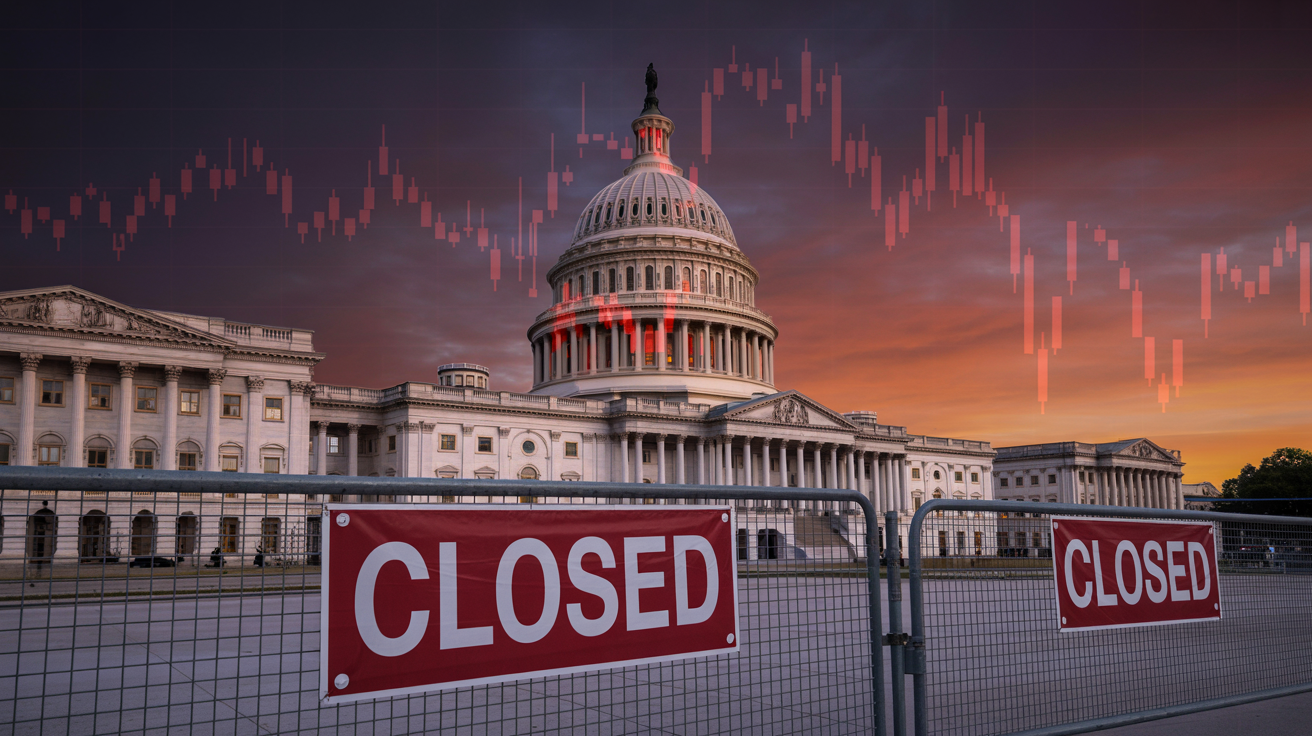
As of this weekend, the federal government shutdown that began on October 1, 2025, has become the longest in U.S. history .
This prolonged impasse has left approximately 1.4 million federal workers without wages and, critically, has eliminated the release of key economic data that guides market and policy decisions ( Morningstar) ( CNN Shutdown).
- GDP Impact: Goldman Sachs estimated a six-week shutdown could reduce Q4 GDP growth by 1.15 percentage points . The CBO projects a drag of 1-2 percentage points for extended shutdowns ( ) ( New York Times) ( Morningstar).
- Labor Market: With official data suspended, private-sector metrics show concerning trends. The ADP employment report indicated only 42,000 private-sector jobs were added in October, well below earlier 2025 levels ( CNN Jobs).
- Consumer Confidence: The University of Michigan’s preliminary consumer sentiment index fell to its lowest level since June 2022, signaling a deterioration in confidence ( Morningstar).
There is growing concern that if the shutdown extends beyond Thanksgiving, a “full-blown correction” could materialize.
What is the Federal Reserve’s stance on interest rates?
Uncertainty over Federal Reserve policy has elevated market volatility. On October 29, Fed Chair Jerome Powell surprised markets by signaling that a December rate cut is “not a foregone conclusion” . This comes after the Fed cut rates by 25 basis points in October to a range of 3.75%-4.00% ( Goldman Sachs) ( Schwab FOMC).
While Goldman Sachs Research maintains its forecast for a December cut, there is substantial FOMC opposition. Cleveland Fed President Beth Hammack, for example, opposed the October cut, citing elevated inflation concerns ( Reuters Hammack) ( Goldman Sachs).
This policy uncertainty is compressing rate-sensitive equities, even as the Fed plans to end quantitative tightening effective December 1, 2025 ( Schwab FOMC).
What new geopolitical factors are affecting the market?
Two major geopolitical factors are influencing market sentiment:
- US-China Trade Deal: A new US-China trade accord was announced following a summit in South Korea. The deal, effective November 10, 2025, includes U.S. tariff reductions, China’s suspension of retaliatory tariffs, and commitments on U.S. agricultural purchases ( Market Minute Nov 6). Market reaction was mixed, with Asian equities gaining but energy commodities remaining cautious ( ).
- Ongoing Conflicts: The Russia-Ukraine War continues to disrupt energy supplies via drone attacks on Russian infrastructure. Simultaneously, the persistent Israeli-Palestinian conflict and Houthi attacks in the Red Sea create ongoing trade route uncertainties and energy market premium pricing ( Market Minute Nov 7).
How did the ValueAligned Portfolio (VAP) perform against the S&P 500?
Based on our analysis, the ValueAligned Portfolio (VAP) demonstrated strong absolute and relative performance in 2025, delivering a net return of 16.02% compared to the S&P 500’s total return of 15.63% . This represents 39 basis points of outperformance after fees , validating the portfolio’s active management and conviction-weighted strategy (VAP Annual PDF).
During the challenging week ending November 7, the portfolio declined 1.48% (net), compared to the S&P 500’s 1.74% decline, delivering 26 basis points of outperformance after fees (VAP Weekly PDF) (VAP Annual PDF).
- Concrete Takeaway: The portfolio’s defensive positioning—featuring energy sector allocation (Permian Resources +5.57%) and healthcare dominance (Eli Lilly +7.13%)—cushioned the impact of the mega-cap technology weakness that drove the benchmark lower.
- Critical Insight: This 39 basis points of net YTD outperformance demonstrates that our active management successfully overcame fee drag to deliver superior risk-adjusted returns in 2025 (VAP Annual PDF).
VAP Model Portfolio Performance Summary
| Metric | Performance |
|---|---|
| Weekly Performance (Nov 1-7, 2025) | |
| VAP Gross Return | -1.45% |
| VAP Net Return (1.5% annual fee) | -1.48% |
| S&P 500 Weekly Return | -1.74% |
| Year-to-Date Performance (Jan 1 – Nov 7, 2025) | |
| VAP Gross Return | +17.29% |
| VAP Net Return (1.5% annual fee) | +16.02% |
| S&P 500 YTD Return | +15.63% |
What key holdings drove the VAP’s performance?
The portfolio’s year-to-date alpha stems from several strategic, conviction-weighted positions:
- Healthcare Overweight (Eli Lilly): Eli Lilly (LLY) , with its +19.74% YTD return, was a significant contributor. The company’s 54% revenue growth and raised 2025 guidance vindicated the portfolio’s conviction weighting ( PR Newswire) ( Investors.com) ( CNBC).
- Selective Technology Exposure: The portfolio concentrated in high-conviction names like AMD (+93.34% YTD) while avoiding many overvalued software names that collapsed (like The Trade Desk -14.48%). This enabled participation in tech leadership while limiting downside.
- Energy Sector Positioning (Permian Resources): Permian Resources (PR) provided exposure to the week’s top-performing sector (Sector PDF) with exceptional operational execution—record free cash flow, production growth (+18.2% YoY), a fortress balance sheet (0.8x leverage), and an attractive 4.8% dividend yield ( Investing.com Transcript) ( Yahoo Finance Beat) ( Yahoo Finance Strong).
- Quality Industrials: Tyson Foods (+47.08% YTD) and Markel Group (+18.02% YTD) demonstrated the portfolio’s emphasis on operational excellence and defensive business models.
VAP Top Five Weekly Performers
| Rank | Ticker | Company | Close | 1W % | YTD % | Summary |
|---|---|---|---|---|---|---|
| 1 | LLY | Eli Lilly | $924.37 | +7.13% | +19.74% | GLP-1 market dominance: 54% revenue growth, raised FY2025 guidance |
| 2 | PR | Permian Resources | $13.26 | +5.57% | -7.79% | Record free cash flow $469M; production +18.2% YoY; $21 PT (65% upside) |
| 3 | IBP | Installed Building Products | $257.76 | +3.84% | +47.08% | Residential/Commercial insulation installer; benefited from construction demand and margin expansion |
| 4 | FIS | Fidelity National Info | $64.78 | +3.61% | -19.80% | Broad fintech platform;dtsbility smid industry consolidation smf deensive flows |
| 5 | MKL | Markel Group | “$2,037.32” | +3.18% | +18.02% | Insurance underwriting profitability is expanding |
VAP Bottom Five Weekly Performers
| Rank | Ticker | Company | Close | 1W % | YTD % | Summary |
|---|---|---|---|---|---|---|
| 496 | CDW | CDW Corp. | $142.45 | -10.62% | -18.15% | Technology distribution weakness; enterprise IT capex uncertainty |
| 497 | AMD | Advanced Micro Devices | $233.54 | -8.82% | +93.34% | Profit-taking despite record Q3; Analyst Day Nov 11 key catalyst |
| 498 | CRM | Salesforce | $239.88 | -7.88% | -28.25% | Enterprise software weakness; AI monetization questions |
| 499 | NVO | Novo Nordisk | $45.68 | -7.64% | -46.90% | GLP-1 market share loss to Lilly; competitive pressure |
| 500 | NVDA | NVIDIA | $188.15 | -7.08% | +40.11% | Semiconductor profit-taking; AI spending cycle concerns |
What is the market outlook, and what should investors watch next week?
Our analysis concludes that the market is at a critical inflection point, reassessing high technology valuations against a backdrop of mounting economic uncertainty. The VAP’s emphasis on operational excellence, earnings quality, and valuation discipline positions it favorably as market leadership broadens beyond mega-cap tech.

Bull Case
The government shutdown resolves by mid-week, strong semiconductor outlooks from AMD and Applied Materials reinvigorate tech, and healthcare momentum accelerates.

Bear Case
The shutdown extends beyond Thanksgiving, semiconductor earnings disappoint on slowing AI capex growth, and tech valuation compression intensifies.
Clear Next Actions: A Framework for the Week Ahead
Investors should monitor the following key catalysts to determine the market’s next move:
- Monitor Government Shutdown News: A resolution is essential for the resumption of economic data and the stabilization of consumer confidence.
- Watch Key Earnings:
- Mon, Nov 10: Occidental Petroleum, Tyson Foods
- Wed, Nov 12: Cisco Systems, TransDigm Group
- Thu, Nov 13: Applied Materials, Walt Disney Company
- Focus on AMD Analyst Day (Nov 11): This is a pivotal catalyst for the entire semiconductor sector. Details on the MI500-series GPU roadmap and data center revenue guidance will be critical for resetting AI infrastructure growth narratives ( Barchart Nov 11) ( Barchart AMD Test).
- Assess the Leadership Rotation: The core question for investors is whether technology sector earnings growth can justify current multiples. If not, the current rotation from expensive growth toward reasonably valued cyclicals and quality value (like energy and healthcare) will intensify.
ENDNOTES
- https://www.stl.news/wall-street-ends-the-week-uneasy-nov-7-2025/
- https://abcnews.go.com/Business/wireStory/major-us-stock-indexes-fared-wednesday-1152025-127235617
- https://www.stl.news/wall-street-ends-the-week-uneasy-nov-7-2025/https://stockanalysis.com/etf/rsp/history/
- https://www.stl.news/wall-street-ends-the-week-uneasy-nov-7-2025/https://economictimes.com/news/international/us/sp-500-dow-remains-positive-nasdaq-falls-as-wall-street-ends-mixed-on-signs-of-shutdown-progress-eos-energy-enterprises-soars-70-davis-commodities-plunges-nearly-78-check-top-gainers-and-losers/articleshow/125176955.cms
- https://www.stl.news/wall-street-ends-the-week-uneasy-nov-7-2025/https://www.chartmill.com/news/ALB/Chartmill-37393-Fridays-session-top-gainers-and-losers-in-the-SP500-index
- https://www.stl.news/wall-street-ends-the-week-uneasy-nov-7-2025/https://www.chartmill.com/news/APP/Chartmill-37391-Gapping-SP500-stocks-in-Fridays-session
- sector.pdf
- https://www.prnewswire.com/news-releases/lilly-reports-third-quarter-2025-financial-results-highlights-rd-pipeline-momentum-and-raises-2025-guidance-302599148.html
- https://www.stl.news/wall-street-ends-the-week-uneasy-nov-7-2025/https://www.investors.com/news/technology/eli-lilly-stock-eli-lilly-earnings-q3-2025/
- https://www.stl.news/wall-street-ends-the-week-uneasy-nov-7-2025/https://www.cnbc.com/2025/10/30/eli-lilly-lly-earnings-q3-2025.html
- https://www.stl.news/wall-street-ends-the-week-uneasy-nov-7-2025/https://finance.yahoo.com/news/permian-resources-q3-earnings-beat-145700151.html
- https://www.stl.news/wall-street-ends-the-week-uneasy-nov-7-2025/https://finance.yahoo.com/news/permian-resources-announces-strong-third-210600428.html
- https://www.stl.news/wall-street-ends-the-week-uneasy-nov-7-2025/https://www.investing.com/news/transcripts/earnings-call-transcript-permian-resources-beats-q3-2025-eps-forecast-93CH-4339391
- https://www.stl.news/wall-street-ends-the-week-uneasy-nov-7-2025/https://www.theglobeandmail.com/investing/markets/stocks/PR/pressreleases/35969609/permian-resources-reports-strong-q3-2025-results/
- https://www.stl.news/wall-street-ends-the-week-uneasy-nov-7-2025/https://www.reuters.com/business/amd-forecasts-fourth-quarter-revenue-above-estimates-2025-11-04/
- https://www.stl.news/wall-street-ends-the-week-uneasy-nov-7-2025/https://www.barchart.com/story/news/35963889/dear-amd-stock-fans-mark-your-calendars-for-november-11
- https://www.stl.news/wall-street-ends-the-week-uneasy-nov-7-2025/https://www.barchart.com/story/news/35988125/amds-rally-faces-a-crucial-test-on-november-11-should-you-buy-sell-or-hold
- https://www.stl.news/wall-street-ends-the-week-uneasy-nov-7-2025/https://ir.amd.com/news-events/press-releases/detail/1265/amd-reports-third-quarter-2025-financial-results
- https://www.stl.news/wall-street-ends-the-week-uneasy-nov-7-2025/