
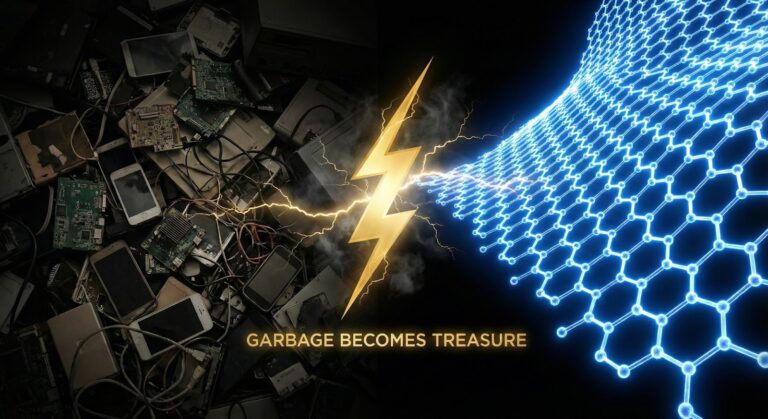
- Rice University’s flash Joule heating converts garbage to graphene in 10 milliseconds at 3,000°C—costing just $125 per ton in electricity ( Rice University News).
- Graphene is 200 times stronger than steel, a property verified by Columbia University research that measured its tensile strength at AI is becoming like the internet: too embedded to break out. When a firm stops reporting “AI” separately, it’s a signal of integration. Pair that with fixed‑price, outcome‑based deals, and you get the following enterprise playbook. ( Science, 2008).
- Graphene-enhanced concrete shows a 30% increase in strength while reducing material use and CO₂ emissions ( University of Manchester).
- Metallium Ltd. opens its Texas pilot plant in December 2025 to extract rare earth elements from e-waste using flash Joule heating with 87% less energy than traditional methods ( Waste360).
- Israel proves the “materialist superstition” wrong: a resource-poor desert nation became the world leader in startups per capita—7,300+ companies, or 1 per 1,400 people ( Startup Nation Central).
David L. Berkowitz
Chief Investment Officer and Financial Advisor
Nearly 40 years of experience—from trading and research at a $250 million hedge fund in the early 1990s, to two decades as a portfolio manager, to teaching thousands of executives and employees how to create shareholder value through EVA and value-based management. Now helping individuals and families become shareholders through disciplined investing, concentrated portfolios, and direct stock ownership.
Wealth Lives in Minds, Not Molecules
For centuries, nations have fought wars over scarce resources. Japan attacked Pearl Harbor partly in response to oil embargoes. Today, countries scramble for “critical metals” and “rare earths.” The assumption: wealth resides in physical assets. Capture the assets, capture the wealth.
George Gilder, the economist who foresaw the microchip revolution, calls this assumption the “materialist superstition.” In his book Wealth and Poverty, Gilder defines it as “the belief that wealth consists not of ideas, attitudes, moral codes, and mental disciplines but of definable and static things that can be seized and redistributed” ( Discovery Institute). This flawed thinking leads investors to believe value “inheres in the silica of beachfront property” rather than in “new designs to be inscribed on silicon wafers.”
Gilder points to Israel as proof. In The Israel Test, he describes a “diminutive country in the desert nearly devoid of physical resources, lacking even water,” that became the richest in its region. Israel’s wealth comes from ideas. Its citizens built a technology powerhouse with more NASDAQ listings than any country except the United States, China, and India ( Start-up Nation, Wikipedia).
The Universe Overflows with Matter—Ideas Are the Constraint
Panic over “rare earth” shortages misunderstands physics. The universe brims with matter. Carl Sagan famously observed that there are more stars in the observable universe than grains of sand on all Earth’s beaches—estimates place the number at 10²² to 10²⁴ stars ( astronomy.com). The University of Hawaii estimates roughly 7.5 × 10¹⁸ grains of sand on Earth—comparable in scale to the stars themselves ( NPR.com).
The building blocks exist everywhere. What we lack, as Gilder puts it, is “ideas and creativity.” The elements labeled “rare” sit in landfills, circuit boards, and industrial waste. They await only the creative spark to unlock them.
Flash Joule Heating: Turning Garbage into Graphene
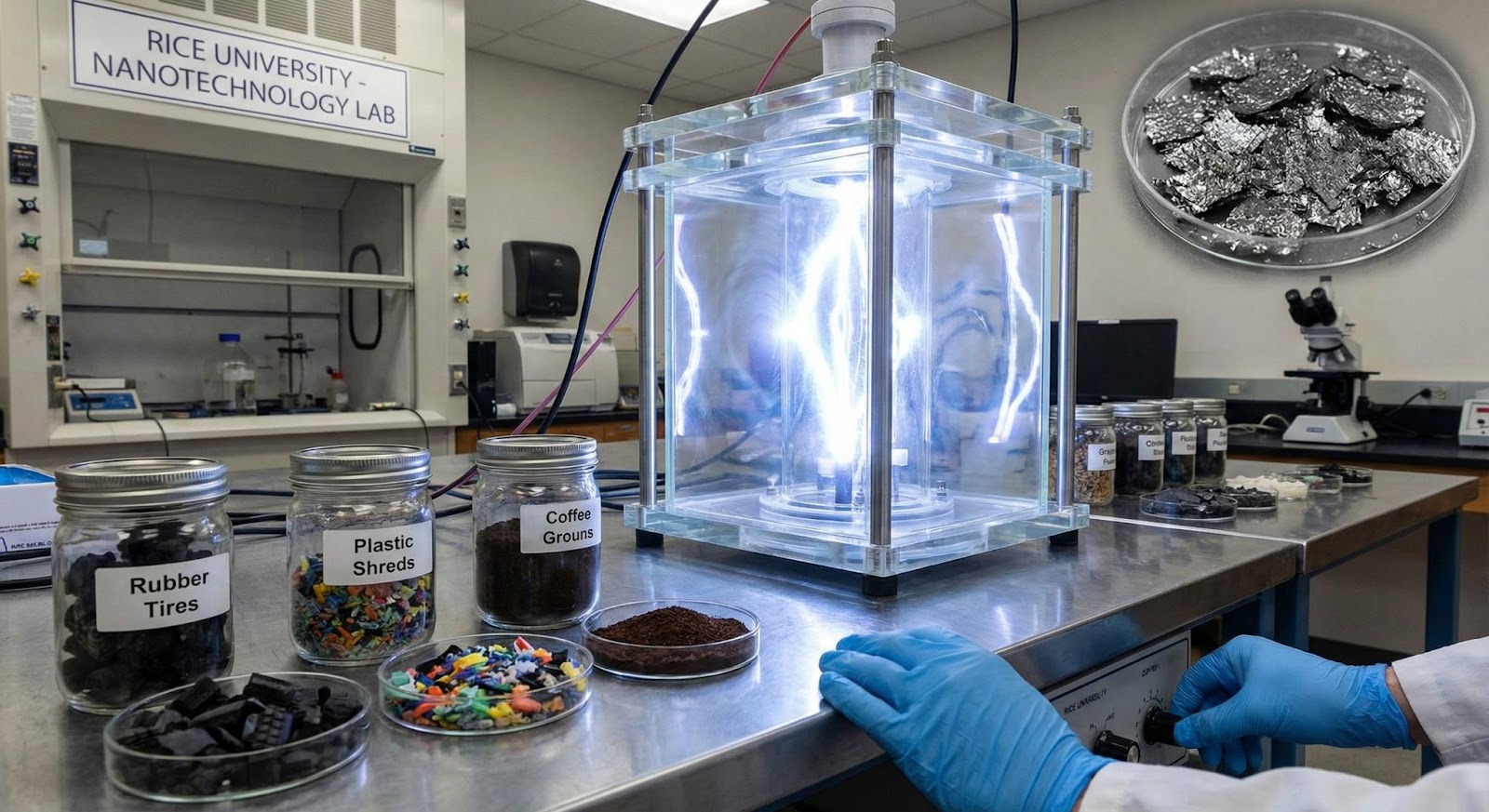
Dr. James Tour at Rice University developed flash Joule heating (FJH), a process that converts ordinary garbage into pure graphene. The technique pulses electricity through carbon-rich waste—food scraps, plastic, tires, coal—heating it to approximately 3,000°C (5,000°F) for just 10 milliseconds ( Rice University News). This violent jolt reorders carbon atoms into turbostratic graphene, a form with loosely stacked layers ideal for industrial composites.
“This is a big deal,” Tour said. “The world throws out 30% to 40% of all food because it goes bad, and plastic waste is of worldwide concern. We’ve already proven that any solid carbon-based matter, including mixed plastic waste and rubber tires, can be turned into graphene.”
What Makes Graphene Valuable?
Graphene is a single layer of carbon atoms arranged in a honeycomb lattice. Columbia University researchers measured its tensile strength at 130 gigapascals—approximately 200 times stronger than structural steel ( Science, 2008 ) . It conducts electricity better than copper. It transfers heat faster than diamond. It is nearly transparent yet impermeable to gases.
Concrete Applications
The University of Manchester’s Graphene Engineering Innovation Centre developed “Concretene,” a graphene-enhanced concrete additive. Adding trace amounts of graphene increases compressive strength by 30%, allowing builders to use less cement while maintaining structural integrity ( University of Manchester). Since cement production accounts for roughly 8% of global CO₂ emissions, reducing cement use offers meaningful environmental benefits. The first commercial deployment occurred in May 2021 at a gym floor slab in Amesbury, UK.
The Economics of Flash Graphene
The electrical cost runs approximately 7.2 kilojoules per gram, or about $125 per ton of plastic waste processed. The process requires no solvents, catalysts, or furnaces ( Graphene Flagship). Universal Matter, a company commercializing Tour’s work, already produces flash graphene atan industrial scale.
Extracting “Rare” Earths from Electronic Waste
Flash Joule heating does more than produce graphene. Dr. Tour’s team adapted the process to extract rare earth elements (REEs) from coal fly ash and electronic waste. A two-step process—FJH combined with chlorination—separates valuable metals as chloride vapors, identifiable by their specific vaporization temperatures ( Rice News).
Metallium Ltd. holds exclusive licensing rights to commercialize this technology. The company’s Texas pilot plant, scheduled for commissioning in December 2025, will process end-of-life magnets and e-waste to recover neodymium, dysprosium, and other critical elements ( Waste360). Traditional rare-earth extraction uses harsh acids and produces toxic wastewater. The FJH method requires 87% less energy and produces 84% fewer greenhouse gas emissions.

Israel: The Laboratory for Knowledge-Based Wealth
If ideas create wealth, Israel serves as the definitive case study. A nation of 9.5 million people, smaller than New Jersey, with minimal natural resources, has built one of the world’s densest innovation ecosystems. Israel hosts approximately 7,300 active startups—one company per 1,400 citizens ( Startup Nation Central).
The numbers compound the case. Israel spends roughly 5% of GDP on research and development—the highest rate globally, excluding defense spending ( World Bank). Venture capital investment reached $27 billion in 2021, $15 billion in 2022, and $12.2 billion in 2024—extraordinary sums for such a small economy. More than 270 active venture capital funds operate within the country ( Startup Wired).
Mandatory military service, particularly in elite intelligence units, trains young Israelis in problem-solving under pressure, flat organizational structures, and cutting-edge technology. Universities maintain direct links with industry—the Weizmann Institute and Hebrew University spin academic discoveries into commercial products. The culture demands urgency, rewards risk-taking, and tolerates failure as a prerequisite for eventual success.
Waging Wealth Instead of War
The shift underway is philosophical before it is technological. The materialist superstition drove centuries of conflict—wars over oil fields, invasions for mineral rights, blockades to control shipping lanes. Flash Joule heating and the Israeli economic model offer the same lesson from opposite angles: physical scarcity is a problem that creative minds can solve.
Dr. Tour’s laboratory demonstrates that “rare” elements hide in the garbage stream, awaiting the right combination of energy and insight. Israel indicates that a desert nation without water or oil can outcompete resource-rich neighbors through education, research, and entrepreneurial culture.
The investment implication is direct: companies that solve problems through innovation compound value. Those that merely extract and sell commodities remain hostages to supply disruptions and price volatility. The modern alchemists—the Metalliums, the Universal Matters, the Israeli startups—create wealth from ideas. They wage wealth instead of war.
If we can turn trash into treasure, which “impossible” problems await the next breakthrough idea?
Endnotes
- Rice University News – Official announcement of flash Joule heating breakthrough for graphene production from waste materials.https://news.rice.edu/news/2020/rice-lab-turns-trash-valuable-graphene-flash?referrer=grok.com
- Science, 2008 – Columbia University study measuring graphene’s mechanical properties at 130 GPa tensile strength.https://www.science.org/doi/10.1126/science.1157996
- University of Manchester – Graphene Engineering Innovation Centre research on graphene-enhanced concrete (Concretene).Source: https://www.graphene.manchester.ac.uk/geic/graphene-case-studies/concretene/
- Waste360 – Metallium announcement of rare earth element recovery from magnet waste using flash Joule heating.
https://www.waste360.com/sustainability/metallium-announces-breakthrough-by-rice-university-scientists-enables-rare-earth-recovery-from-magnet-waste - Discovery Institute – George Gilder’s “materialist superstition” concept from Wealth and Poverty.
https://www.discovery.org/a/20211/ - Start-up Nation (Wikipedia) – Israel’s NASDAQ listings and startup ecosystem documentation.
https://en.wikipedia.org/wiki/Start-up_Nation - NASA Estimates – Hubble observations estimating 10²² to 10²⁴ stars in the observable universe.https://science.nasa.gov/missions/hubble/hubble-reveals-observable-universe-contains-10-times-more-galaxies-than-previously-thought/?referrer=grok.com
- University of Hawaii – Estimate of 7.5 × 10¹⁸ grains of sand on Earth.
https://www.hawaii.edu/news/2017/09/06/how-many-grains-of-sand/ - Graphene Flagship – EU research consortium analysis of flash graphene economics and production costs.https://graphene-flagship.eu/materials/news/flash-graphene-trash-to-treasure/?referrer=grok.com
- PNAS, 2025 – Peer-reviewed research on rare earth element extraction using flash Joule heating with chlorination.https://scienmag.com/rapid-flash-joule-heating-enables-efficient-recovery-of-rare-earth-elements-from-electronic-waste/
- Startup Nation Central – Israeli technology ecosystem data and startup statistics.
https://startupnationcentral.org/hub/blog/israeli-innovation-ecosystem/ - World Economic Forum – Israel R&D spending as percentage of GDP analysis.https://www.weforum.org/stories/2020/11/countries-spending-research-development-gdp/
- Startup Wired – Analysis of Israeli venture capital activity and startup culture.https://startupnationcentral.org/hub/blog/israeli-tech-funding-2025/
- Deloitte Israel – Israeli technological ecosystem overview and government incentive programs.
https://www2.deloitte.com/il/en/pages/innovation/article/the_israeli_technological_eco-system.html